New FDA Guidance Clarifies Policy for Low-Risk General Wellness Devices
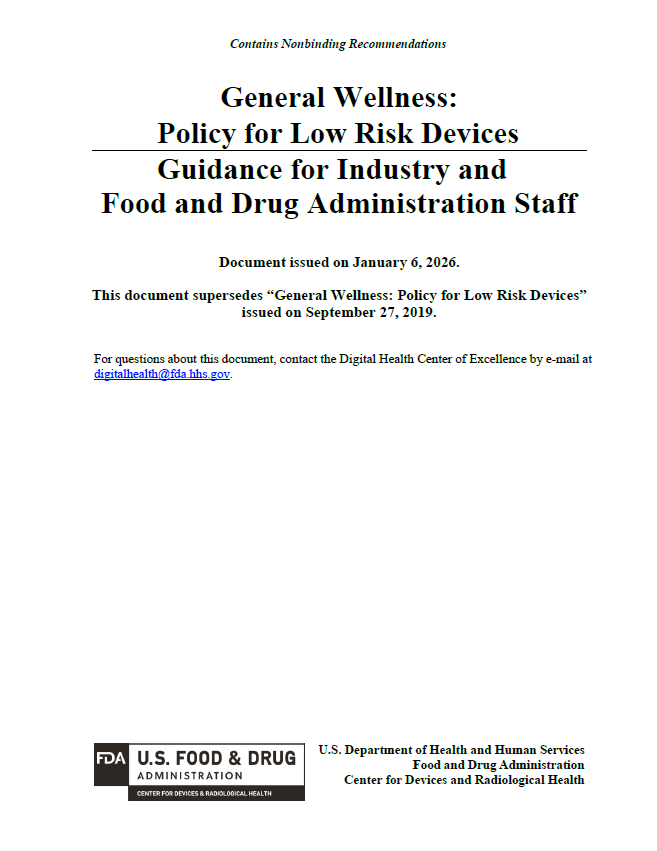
On January 6, 2026, the FDA issued an updated version of its guidance document “General Wellness: Policy for Low Risk Devices”, replacing the 2019 edition. The guidance outlines the FDA’s enforcement discretion policy for low-risk products that promote a healthy lifestyle — especially those that may be considered medical devices under U.S. law but pose minimal risk to users.
This policy remains nonbinding and reflects the current thinking of the FDA’s Center for Devices and Radiological Health (CDRH). It is intended to provide clarity for manufacturers developing software, wearables, and lifestyle devices.
Key criteria: When does the FDA apply enforcement discretion?
According to the guidance, products must meet two conditions to qualify as “low-risk general wellness” products:
Intended Use
The product must either:Promote a general state of health (e.g., physical fitness, relaxation, mental acuity, sleep, self-esteem, or sexual function),
Or support healthy lifestyle choices that may help reduce the risk of or support living well with a chronic condition, such as type 2 diabetes or hypertension.
These claims must be broadly accepted by the scientific community (e.g., peer-reviewed publications, statements by medical societies).
Low Risk to Safety
The product must be:Non-invasive,
Not implanted,
And must not involve technologies that require special controls (e.g., lasers, radiation, invasive sensors).
For example, basic fitness trackers, wellness coaching apps, or sleep monitors may fall under this policy — as long as no diagnostic or clinical claims are made.
Importantly, if a product includes clinical claims, references to diagnosis or treatment, or mimics clinical outputs without validation, it falls outside the scope of this guidance.
Why it matters for manufacturers
While this policy does not change the definition of a medical device, it offers a pathway for manufacturers to bring wellness-focused technologies to market without undergoing FDA’s full premarket regulatory process — provided they meet the outlined criteria.
For companies operating in the digital health, wearables, or consumer wellness space, this policy provides much-needed flexibility — but it requires careful attention to claims, functionality, and risk.
The guidance also clarifies how products that estimate physiologic parameters (e.g., heart rate, oxygen saturation, or blood pressure) can still be considered general wellness products if used only for wellness purposes and not for medical decision-making.
What should manufacturers do now?
Manufacturers of wellness-related technologies — especially software developers, wearable tech companies, and digital health platforms — should:
Review product claims to ensure they stay within the “general wellness” scope.
Avoid references to disease, treatment, or diagnosis unless fully regulated as medical devices.
Evaluate risk profiles: invasive or higher-risk products do not qualify.
Consider whether outputs or interfaces suggest clinical utility, which could trigger FDA regulation.
You can download the full guidance directly below.