MHRA Updates Real-World Evidence Guidance for Medicines and Medical Devices
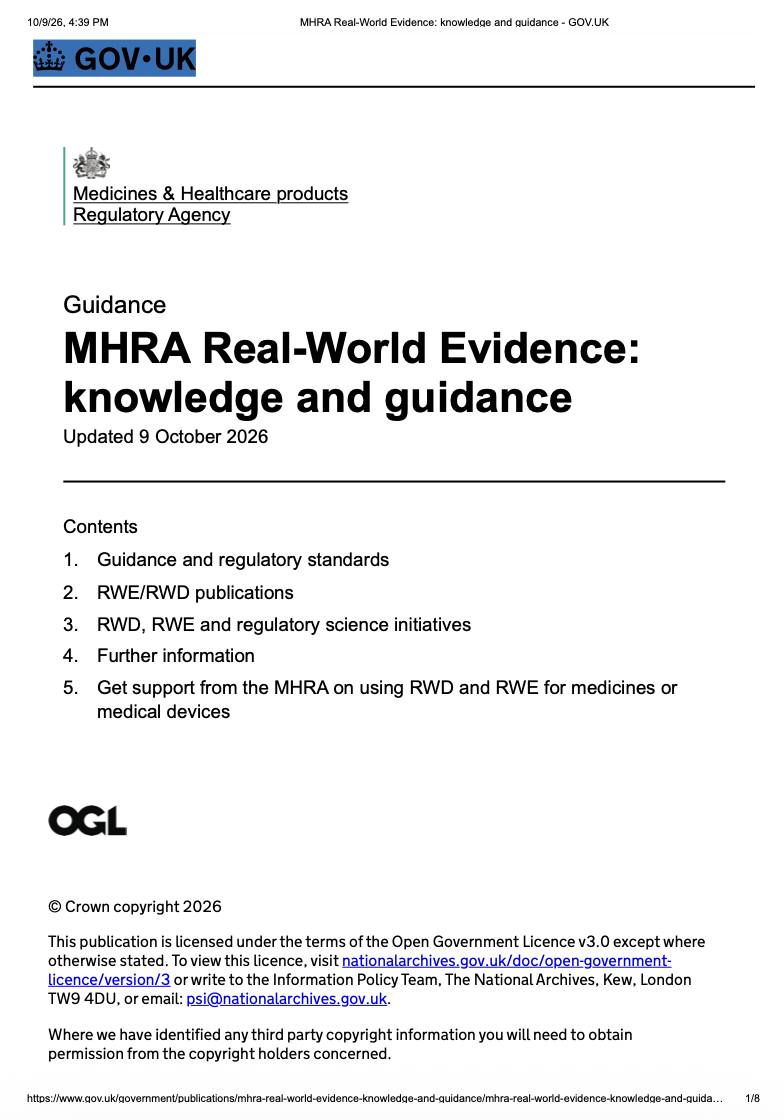
The UK Medicines and Healthcare products Regulatory Agency (MHRA) has updated its “Real-World Evidence: knowledge and guidance” resource.
Updated on 9 October 2026, the publication brings together regulatory guidance, standards, scientific publications, initiatives and support mechanisms related to the generation and use of Real-World Data (RWD) and Real-World Evidence (RWE). 1791783561052
The resource is relevant to both medicines and medical devices, reflecting the growing role of real-world evidence across the regulatory lifecycle.
Guidance and Regulatory Standards
MHRA states that the listed standards and guidelines provide principles supporting the generation, assessment and regulatory use of RWD and RWE. 1791783561052
The resource includes MHRA-authored guidance on the use of real-world data in clinical studies to support regulatory decisions.
This guidance addresses whether a particular RWD source is of sufficient quality for its intended regulatory use. 1791783561052
Randomised Trials Using Real-World Data
MHRA also points to its guidance on randomised controlled trials using RWD.
The document covers considerations for prospective randomised trials using real-world data sources where the evidence is intended to support a regulatory decision.
Topics include:
clinical trial authorisation;
study design;
endpoint selection;
safety data requirements. 1791783561052
External Control Arms
The resource also references MHRA’s draft guideline on using external control arms based on real-world data.
The guideline provides principles for sponsors planning clinical trials that incorporate RWD-derived external controls and require regulatory approval. 1791783561052
International Regulatory Standards
MHRA’s updated resource also references several internationally recognised guidelines relevant to RWD and RWE.
These include:
ICH M14, covering non-interventional studies using RWD for medicines safety assessment;
ICH E6(R3), addressing Good Clinical Practice and including considerations for innovative trial designs and RWD;
ICH E8(R1), covering general considerations for clinical studies and quality-by-design principles. 1791783561052
How MHRA Defines Real-World Data
MHRA defines RWD as data relating to patient health status or healthcare delivery that are collected outside a clinical study.
Examples include:
electronic healthcare records;
primary and secondary care records;
disease registries;
administrative birth and death data;
patient-reported outcomes;
wearable device data;
data collected through specialised or secure websites;
tablet-based data. 1791783561052
Use of RWD and RWE in Regulatory Decision-Making
MHRA states that RWD may be used in clinical studies intended to support regulatory decisions.
It is also widely used to monitor the performance of medicines and medical devices following regulatory approval. 1791783561052
MHRA notes that RWE may sometimes provide evidence that is more representative of treatment effects in the community than evidence generated in the standardised environment of a traditional clinical trial.
However, suitability depends on:
the regulatory question;
quality of the data source;
suitability of the data;
study design;
study conduct. 1791783561052
Regulatory Science Initiatives
The updated resource highlights several initiatives supporting broader use of RWD and RWE.
These include the MHRA Data Strategy 2024–2027, which describes the Agency’s ambition to become a data-enabled regulator and strengthen the use of health data, analytics and evidence throughout the product lifecycle. 1791783561052
It also references the Clinical Practice Research Datalink (CPRD), a UK real-world data research service supporting observational and interventional research. 1791783561052
ICH E23 Development
MHRA is also contributing to the development of ICH E23 — Considerations for the Use of Real-World Evidence to Inform Regulatory Decision Making with a Focus on Effectiveness of Medicines.
The initiative is intended to support a more harmonised international approach to the regulatory use and assessment of RWD and RWE. 1791783561052
MHRA-NICE Real-World Evidence Scientific Dialogue
The resource highlights the MHRA–NICE Real-World Evidence Scientific Dialogue, a workshop series designed to support decision-making across the product lifecycle.
The programme provides a pre-competitive “safe harbour” environment where stakeholders can discuss:
study designs;
data sources;
analytical approaches;
regulatory evidence needs;
health technology assessment evidence needs. 1791783561052
Support for Medicines Developers
MHRA offers several routes for developers seeking advice on RWD and RWE strategies.
These include:
MHRA Scientific Advice;
integrated MHRA-NICE Scientific Advice;
MHRA-NICE RWE Scientific Dialogue;
Innovative Licensing and Access Pathway (ILAP);
Early Access to Medicines Scheme (EAMS). 1791783561052
These mechanisms can help developers align evidence-generation strategies with regulatory and, where relevant, HTA expectations.
Support for Medical Device Manufacturers
The updated guidance is also directly relevant to medical device and IVD developers.
MHRA states that Medical Device Regulatory Advice can help developers discuss regulatory requirements and understand evidence expectations, including circumstances where RWD or RWE may support demonstration of safety and performance. 1791783561052
The MHRA Innovation Office also provides access to regulatory expertise for innovative medicines, medical devices and technologies. 1791783561052
Impact on Medical Device and Pharmaceutical Companies
The updated MHRA resource reinforces the increasing importance of real-world evidence within the UK regulatory environment.
For manufacturers and sponsors, important considerations include:
ensuring RWD sources are fit for purpose;
maintaining appropriate data quality and integrity;
aligning study design with the intended regulatory question;
considering RWE throughout the product lifecycle;
integrating RWD into post-market monitoring;
engaging early with MHRA where evidence strategies are novel or complex.
For medical device manufacturers in particular, RWE may become increasingly important in supporting safety, performance and lifecycle evidence generation after market access.