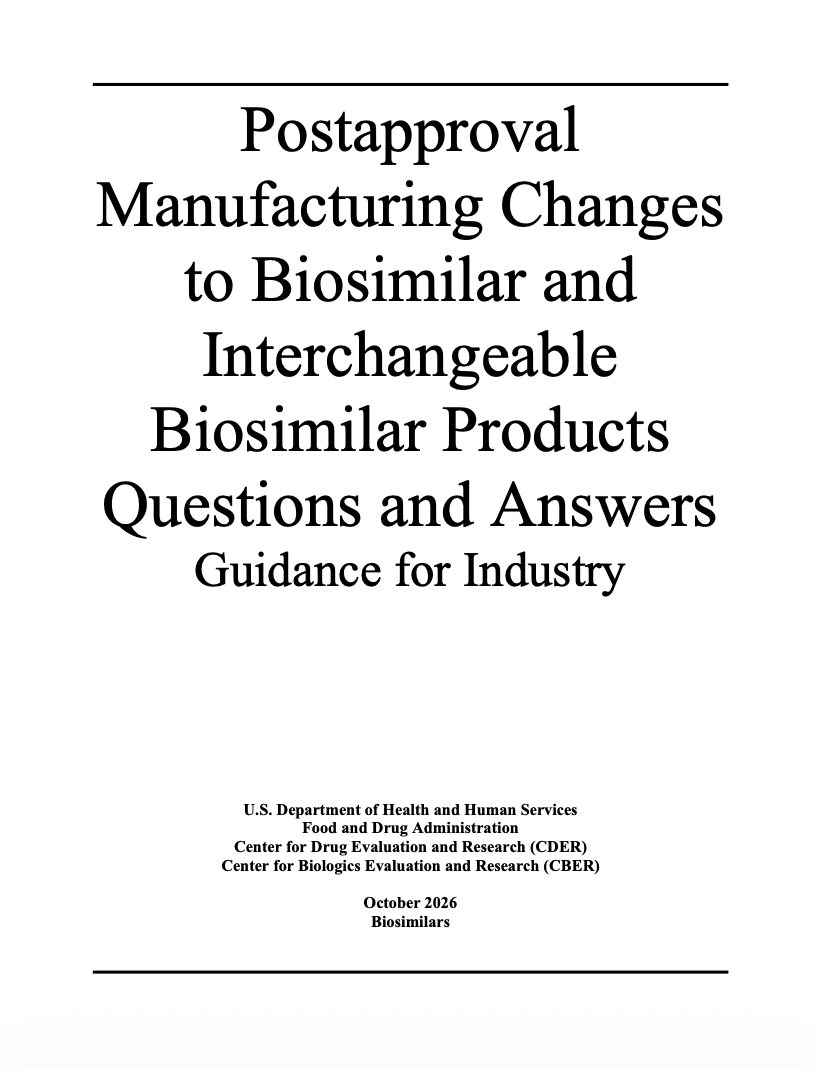
FDA Issues Guidance on Postapproval Manufacturing Changes for Biosimilars
The U.S. Food and Drug Administration (FDA) has issued “Postapproval Manufacturing Changes to Biosimilar and Interchangeable Biosimilar Products: Questions and Answers – Guidance for Industry”.
Published in October 2026, the guidance is intended to clarify the type of information applicants should provide when making manufacturing changes to licensed biosimilars and interchangeable biosimilars. 1791784772898
Scope of the Guidance
The guidance applies to products licensed under section 351(k) of the Public Health Service Act that have been determined to be biosimilar to, or interchangeable with, an FDA-licensed reference biological product. 1791784772898
FDA explains that applicants must assess the impact of manufacturing changes and demonstrate that those changes do not adversely affect product quality, including:
identity;
strength;
quality;
purity;
potency.
These considerations are linked to the safety and effectiveness of the product. 1791784772898
Alignment With ICH Q5E
The guidance is intended to be consistent with the principles in ICH Q5E – Comparability of Biotechnological/Biological Products Subject to Changes in Their Manufacturing Process. 1791784772898
FDA therefore expects manufacturers to use a comparability-based approach when evaluating postapproval manufacturing changes.
Reporting Categories for Manufacturing Changes
FDA describes the reporting categories that may apply to postapproval manufacturing changes under 21 CFR 601.12.
These include:
Prior Approval Supplement (PAS) for major changes;
Changes Being Effected in 30 Days (CBE-30) for moderate changes;
Changes Being Effected (CBE-0) in certain circumstances;
Annual Report for minor changes. 1791784772898 1791784772898
The appropriate category depends on the potential impact of the change on product quality, safety and effectiveness.
Prior Approval Supplements
A PAS is required for major changes with a substantial potential to adversely affect product quality.
FDA approval of the PAS is required before distribution of product manufactured using the change. 1791784772898
Applicants may also submit a comparability protocol that, if approved, could support a reduced reporting category for specified future CMC changes.
CBE-30 and CBE-0 Supplements
Moderate changes may be submitted through a CBE-30 supplement.
In this case, FDA must receive the supplement at least 30 days before distribution of the product manufactured using the change. 1791784772898
In certain circumstances, FDA may permit distribution immediately upon receipt of the supplement through a CBE-0mechanism, including where an approved comparability protocol supports the change. 1791784772898
Annual Reports for Minor Changes
Minor manufacturing changes with minimal potential to adversely affect product quality may be documented in the applicant’s Annual Report. 1791784772898 1791784772898
FDA also expects applicants to clearly identify the applicable reporting category in their submissions and to list all relevant changes in the cover letter. 1791784772898
Comparability Exercise
A central requirement in the guidance is the comparability exercise.
FDA recommends that applicants compare the biosimilar product before and after the manufacturing change to demonstrate that the change has not adversely affected the product.
The extent of data required should be proportionate to the nature of the change and its potential effect on quality, safety and efficacy. 1791784772898
The comparability assessment should address:
relevant quality attributes;
appropriate analytical methods;
risk associated with the manufacturing change;
process validation data, where applicable.
Side-by-Side Analytical Comparisons
FDA states that the comparability exercise should generally include a side-by-side analytical comparison of a sufficient number of prechange and postchange lots.
Stability data should also be included where appropriate. 1791784772898
Comparative stability studies may be particularly important where manufacturing changes could affect:
protein structure;
purity;
impurity profiles.
Use of Historical Analytical Data
In some cases, comparison of postchange analytical data against historical prechange data may be sufficient.
Relevant historical information can include data from:
comparative analytical assessment lots;
clinical development lots;
process consistency lots;
commercial lots manufactured after approval. 1791784772898
Where only a subset of historical data is used, FDA expects a scientific justification.
Reference Materials
FDA recommends including a well-qualified in-house reference material in the comparability exercise.
This reference material serves as an important calibration point when evaluating whether the postchange product remains comparable to the prechange product. 1791784772898
If comparability is sufficiently demonstrated, FDA will generally not require additional reference materials beyond the in-house reference material. 1791784772898
Multiproduct Manufacturing Facilities
The guidance also addresses the introduction of biosimilar products into multiproduct manufacturing areas or contract manufacturing facilities.
FDA notes that such changes can introduce risks including:
cross-contamination;
product mix-ups;
inadequate product identification.
Manufacturers should implement appropriate controls, which may include separate manufacturing areas and controls over personnel, processes, material flow and raw materials. 1791784772898
New Dosage Forms or Strengths
FDA also provides recommendations for supplements proposing a new dosage form or new strength that was not previously licensed under the 351(k) BLA.
Such a change is generally considered a major change and would normally require a PAS. 1791784772898
The supplement should generally include:
comparability data;
manufacturing data;
process validation data;
comparative analytical assessment data;
risk assessment;
additional data where necessary, such as pharmacokinetic studies. 1791784772898
Risk-Based Data Expectations
FDA emphasises that the amount of comparability and analytical data submitted should be commensurate with the level of risk associated with the proposed change. 1791784772898
In some cases, previously submitted comparative analytical assessment data may be leveraged if scientifically justified.
Early Engagement With FDA
For supplements involving new dosage forms or strengths, FDA recommends that applicants discuss the proposed analytical and manufacturing data package with the appropriate FDA review division before submission. 1791784772898
Impact on Biosimilar Manufacturers
For biosimilar and interchangeable biosimilar manufacturers, the guidance provides greater clarity on how postapproval CMC changes should be managed.
Key areas to review include:
change control procedures;
reporting category assessment;
PAS, CBE-30 and CBE-0 strategy;
annual report documentation;
comparability protocols;
analytical comparability;
stability assessment;
process validation;
use of historical data;
multiproduct facility controls;
new strength and dosage form submissions.
The guidance reinforces a risk-based, lifecycle approach to manufacturing change management, with comparability remaining central to demonstrating that product quality, safety and efficacy are maintained following a change.