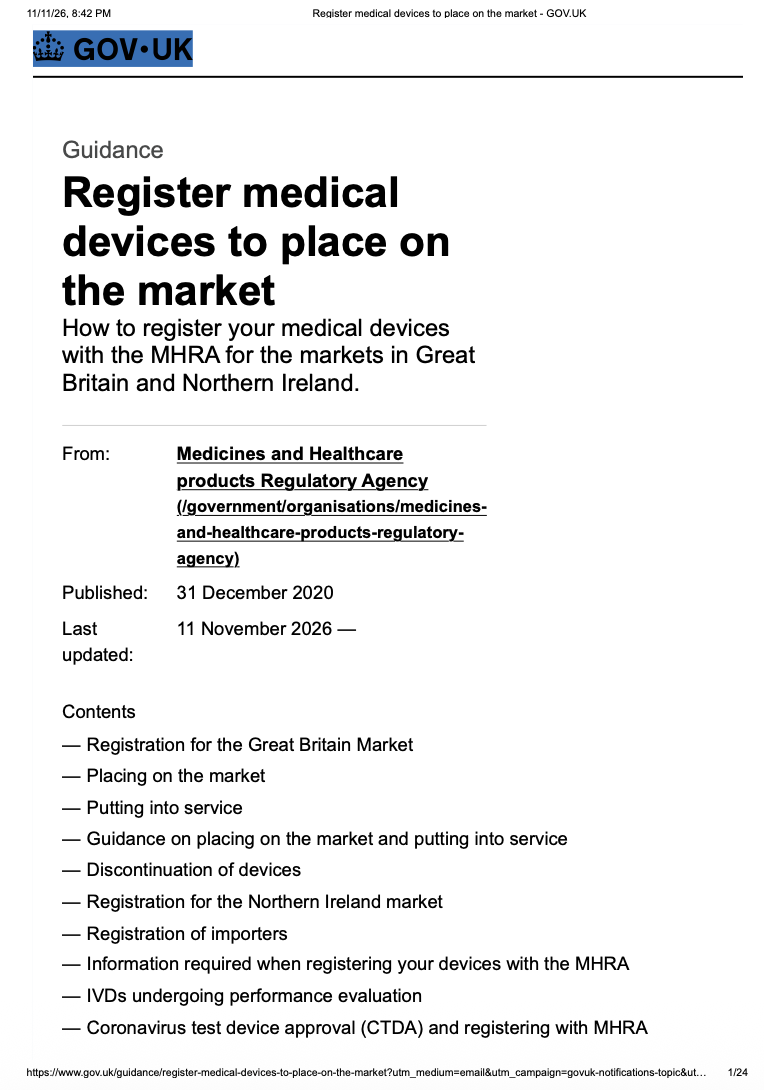
The UK Medicines and Healthcare products Regulatory Agency (MHRA) has updated its guidance on registering medical devices for placement on the markets in Great Britain and Northern Ireland.
The guidance, last updated on 11 November 2026, covers registration requirements, Device Online Registration System (DORS) procedures, annual fees, responsibilities of manufacturers and UK Responsible Persons, importer obligations, EUDAMED registration and transitional arrangements.
All Devices Must Be Registered Before Placement on the GB Market
The MHRA confirms that all medical devices placed on the market in Great Britain must be registered before they are supplied.
This includes:
general medical devices;
in vitro diagnostic medical devices;
custom-made devices;
systems and procedure packs.
Devices placed on the GB market must comply with the UK Medical Devices Regulations 2002 (UK MDR 2002).
Registration Does Not Mean MHRA Approval
The MHRA reiterates that device registration does not constitute:
accreditation;
certification;
regulatory approval;
endorsement by the MHRA.
Manufacturers must therefore not make claims suggesting that registration represents MHRA approval or use MHRA logos in marketing materials, packaging or Instructions for Use.
The Agency may also request additional technical documentation during the registration process to verify conformity with applicable requirements.
Who Must Register in Great Britain?
Registration is required where a manufacturer or company sells, leases, lends or gives away:
Class I devices;
Class IIa devices;
Class IIb devices;
Class III devices;
refurbished or relabelled devices under its own name;
systems or procedure packs;
custom-made devices;
IVDs;
IVDs undergoing performance evaluation.
UK Responsible Person Remains Mandatory for Overseas Manufacturers
Manufacturers established outside the UK must appoint a single UK Responsible Person for all of their medical devices placed on the Great Britain market.
The UK Responsible Person assumes responsibility for registering those devices with the MHRA.
The guidance also notes that DORS accounts belonging to former Great Britain-based Authorised Representatives that had not converted their role to UK Responsible Person by 30 March 2026 have now been closed.
Placing on the Market vs Putting into Service
The updated guidance gives important clarification on the difference between placing on the market and putting into service.
“Placing on the market” refers to the first making available of an individual device for use or distribution on the GB market.
Before that occurs, the device must be registered with the MHRA.
“Putting into service” refers to the point at which the device becomes available to the final user.
Where a device is only put into service and is not placed on the GB market, MHRA registration is encouraged but may not be legally required.
Discontinued Devices Can Be Unregistered
Manufacturers may discontinue supply of a medical device.
Once the device is no longer being made available on the GB market, maintaining the MHRA registration is no longer required.
However, post-market surveillance and vigilance obligations continue for devices already placed on the market.
Major Change for Northern Ireland: EUDAMED Registration
One of the most important points in the guidance concerns Northern Ireland.
Since 28 May 2026, all medical devices other than custom-made devices must be registered in EUDAMED before being placed on the EU and Northern Ireland markets.
From that date, MHRA registration is no longer required for those devices.
Custom-Made Devices Remain Different
Custom-made devices do not need to be registered in EUDAMED.
They must continue to be registered with the MHRA when placed on the Northern Ireland market.
Manufacturers must complete this registration within 28 days of the custom-made device being made available in Northern Ireland.
Authorised Representatives for Northern Ireland
Manufacturers based outside Northern Ireland or the EU must appoint an EU- or Northern Ireland-based Authorised Representative to place devices on the Northern Ireland market.
Great Britain manufacturers must therefore also appoint an appropriate Authorised Representative when accessing the Northern Ireland market.
Importer Requirements
A Great Britain-based importer must inform the manufacturer or UK Responsible Person of its intention to import a device for placement on the GB market.
The manufacturer or UK Responsible Person is then responsible for providing the importer’s details to the MHRA, including the importer’s GB place of business.
Distributors and suppliers that do not perform the importing activity do not need to be separately registered with the MHRA.
Northern Ireland Importers and EUDAMED
Northern Ireland importers must follow the importer obligations established under the EU MDR or IVDR.
From 28 May 2026, EUDAMED registration of Northern Ireland importers is required.
Information Required for MHRA Registration
Manufacturers registering devices must provide detailed organisational and device information.
Manufacturer information includes:
legal entity name;
address;
company type;
administrative contacts;
UK Responsible Person designation letter, where applicable.
Device Information Required
Device registration details may include:
applicable legislation;
device classification;
GMDN code and term;
Basic UDI-DI, where applicable;
device name;
model or version;
catalogue/reference number;
UDI-DI;
UK Approved Body or EU Notified Body;
device characteristics such as sterility, latex content or MRI compatibility.
Manufacturers must also provide conformity assessment certificates or self-certification declarations where applicable.
DORS Remains the Main Registration System
Where MHRA registration is required, manufacturers must create and use an account in the Device Online Registration System (DORS).
A manufacturer is not considered registered until:
the required device information has been submitted;
the MHRA has confirmed registration.
New 2026/2027 Annual Fee Update
The MHRA has completed its 2026/2027 annual fee recalculation.
The calculation now excludes applicable registrations for devices that are put into service only.
The payment deadline for outstanding annual fees for devices placed on the market was 6 November 2026.
Unpaid Accounts May Be Suspended
Accounts with unpaid annual fees after the deadline are suspended.
Where a company has already paid but its account remains suspended, it should verify that the relevant annual fee application has also been submitted through DORS.
Once the application is correctly submitted, the account status can normally return from “Suspended” to “Registered” within minutes.
Annual Fee Structure Introduced in April 2026
A new annual fee structure came into force on 1 April 2026, replacing the previous one-off device registration fee model.
Manufacturers are now charged annually according to the number of Level 2 GMDN Categories under which their products are registered.
Where no Level 2 category exists, the relevant Level 1 category is used.
£300 Per GMDN Category for 2026/2027
For the period from 1 April 2026 to 31 March 2027, the annual unit fee is:
£300 per Level 2 GMDN Category per year, or per Level 1 category where no Level 2 exists.
The fee is expected to change annually.
For registrations made during the charging period, fees are applied on a pro-rata basis.
Registration Capacity Per Application
Each registration application can contain up to:
100 devices/GMDN entries;
a cumulative maximum of 20,000 products.
This can include device names, models, catalogue references and UDI-DIs.
Registration Data Must Be Kept Current
Manufacturers are legally required to keep registered information accurate and up to date.
The previous DORS “Renew registration” function was removed on 1 April 2026.
However, organisations must still regularly review their registration information and update it whenever changes occur.
Some Registration Changes May Trigger Fees
Changes that may result in a statutory fee include:
adding devices in a new GMDN Level 2 category;
changing certain device characteristics;
changing device legislation;
changing UK Responsible Person;
adding represented manufacturers.
Certain changes remain free of charge.
Free Registration Updates
Examples of updates that do not normally trigger a statutory fee include:
company address;
company name;
contact information;
updated designation letters;
additional product details;
removing products no longer marketed;
updating obsolete GMDN terms;
adding or deactivating importers.
CE Transitional Arrangements Remain Relevant
The guidance also explains that certain medical devices with expired or expiring CE certificates may continue to rely on EU MDR transitional arrangements.
Manufacturers may need to upload:
a Notified Body confirmation letter; or
an Article 120 extension confirmation template.
IVDR Transitional Arrangements
Similar provisions apply to certain IVDs whose EU IVDD certificates remain valid under IVDR transitional arrangements.
Manufacturers may need to provide a Notified Body confirmation or the applicable EU IVDR Article 110 Extension Confirmation Template.
IVDs Upclassified Under IVDR
The MHRA also maintains dedicated guidance for IVDs that were previously general IVDs under the IVDD but are now classified as Class B, C or D under the IVDR and therefore require Notified Body involvement.
IVDs Undergoing Performance Evaluation
IVDs undergoing performance evaluation in the UK must be registered by the manufacturer, UK Responsible Person or Northern Ireland Authorised Representative before the study begins.
The MHRA also requires a Declaration for Performance Evaluation under the relevant UK or EU framework.
CTDA Requirements for Coronavirus Tests
Coronavirus antigen or molecular detection tests remain subject to specific Coronavirus Test Device Approval (CTDA)requirements.
Such products cannot be placed on the UK market unless they meet applicable minimum performance standards through the CTDA process.
Registration applications will not generally be accepted until CTDA has been obtained unless an exemption applies.
Public Access Registration Database
Once registered, relevant information becomes available through the Public Access Registration Database (PARD).
Published information may include:
manufacturer name and address;
MHRA reference number;
registered device types;
GMDN term and code;
brand or trade names;
UK Responsible Person or Northern Ireland Authorised Representative details where applicable.
IVDs registered solely for performance evaluation are not published in PARD.
Impact on Manufacturers
For manufacturers placing medical devices on the UK market, the updated guidance reinforces several key priorities:
confirm whether the device is being placed on the market, put into service or both;
maintain accurate DORS registration data;
monitor annual fees;
ensure the correct UK Responsible Person or Authorised Representative arrangements;
distinguish GB registration requirements from Northern Ireland/EUDAMED obligations;
review GMDN classifications;
monitor transitional CE certificate requirements.
Impact on Regulatory Teams
The November 2026 update is particularly relevant because the UK device registration framework is increasingly split between:
MHRA/DORS for Great Britain;
EUDAMED for most Northern Ireland devices;
continued MHRA registration for specific Northern Ireland custom-made devices.
Regulatory teams managing both markets therefore need clear internal procedures to avoid duplicate, missing or outdated registrations.