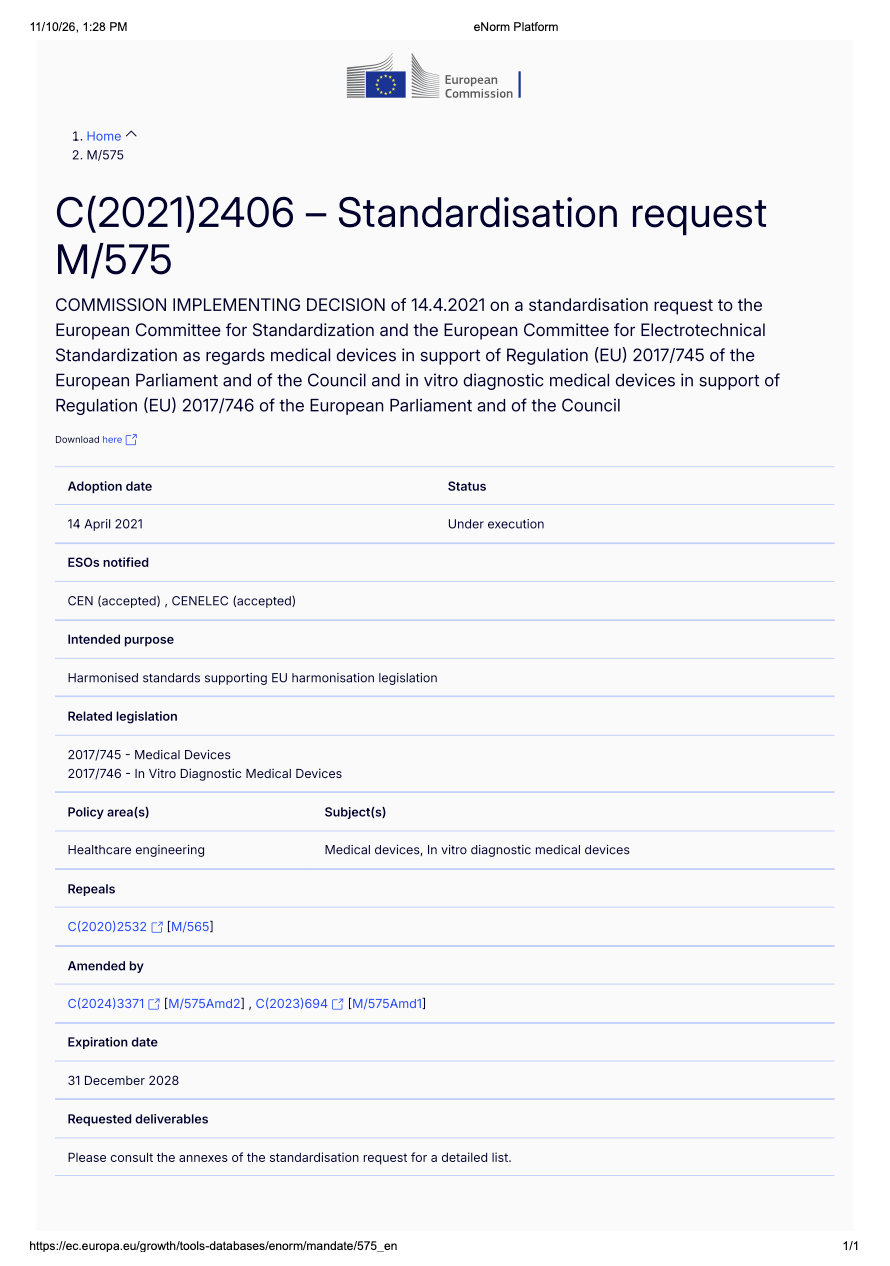
The European Commission’s M/575 standardisation request, which supports the development of harmonised standards for medical devices and in vitro diagnostic medical devices under the MDR and IVDR, remains under execution.
The request was formally adopted on 14 April 2021 and addresses standardisation activities supporting Regulation (EU) 2017/745 on medical devices and Regulation (EU) 2017/746 on in vitro diagnostic medical devices.
M/575 Supports MDR and IVDR Harmonisation
M/575 was issued as a formal standardisation request to:
CEN — European Committee for Standardization;
CENELEC — European Committee for Electrotechnical Standardization.
Both organisations accepted the request.
Its intended purpose is the development of harmonised standards supporting EU harmonisation legislation.
Direct Link to MDR and IVDR
The request specifically supports:
Regulation (EU) 2017/745 — Medical Devices;
Regulation (EU) 2017/746 — In Vitro Diagnostic Medical Devices.
The policy area identified by the Commission is healthcare engineering, with the subjects covering both medical devices and IVDs.
M/575 Replaced M/565
The eNorm Platform confirms that M/575 repealed the previous standardisation request:
C(2020)2532 — M/565.
This established M/575 as the central request supporting harmonised standards under the current MDR and IVDR framework.
Two Amendments Have Already Been Adopted
The standardisation request has subsequently been amended twice.
The Commission identifies:
M/575 Amendment 1 — C(2023)694;
M/575 Amendment 2 — C(2024)3371.
These amendments reflect the ongoing evolution of the European standardisation programme supporting medical device regulation.
Request Remains Under Execution
The current status of M/575 is listed as “Under execution.”
This means the standardisation work assigned to CEN and CENELEC continues.
The request has an expiration date of:
31 December 2028.
Why M/575 Matters for Manufacturers
M/575 is central to the development of the harmonised standards framework supporting the MDR and IVDR.
Once a standard developed under this request is cited in the Official Journal of the European Union, its voluntary use can support presumption of conformity with the relevant regulatory requirements it is intended to cover.
For manufacturers, this can influence:
GSPR mapping;
technical documentation;
risk management;
verification and validation;
usability;
electrical safety;
software;
biological evaluation;
quality management systems;
conformity assessment strategies.
Standardisation Is an Ongoing Process
The fact that M/575 remains under execution until the end of 2028 highlights that the EU harmonised standards framework for MDR and IVDR is still evolving.
Manufacturers should therefore continue to monitor:
newly published harmonised standards;
revised standards;
amendments;
withdrawn references;
transition dates;
changes to M/575 deliverables.
Role of CEN and CENELEC
CEN and CENELEC are responsible for developing the standards requested by the European Commission.
The eNorm Platform confirms that both European Standardisation Organisations have formally accepted M/575.
Their work provides the technical standards that may later be cited in the OJEU and used by manufacturers to support conformity with MDR and IVDR requirements.
Requested Deliverables
The Commission notes that the detailed deliverables requested under M/575 are contained in the annexes to the standardisation request.
These deliverables define the specific standards and standardisation activities expected from CEN and CENELEC.
Impact on Regulatory and Quality Teams
For regulatory and quality teams, M/575 should be considered part of ongoing regulatory intelligence.
Key actions include:
maintaining a standards surveillance process;
reviewing newly harmonised standards;
assessing applicability to existing products;
updating technical documentation where necessary;
documenting transitions between standard editions;
evaluating gaps between current internal practice and newly harmonised requirements.
Continued Development Through 2028
With M/575 still under execution and an expiration date of 31 December 2028, further harmonised standards activity can be expected over the coming years.
For manufacturers, this reinforces the importance of treating harmonised standards monitoring as an ongoing compliance activity rather than a one-time exercise performed only at initial certification.