MedTech Europe Proposes Targeted Reforms to MDR and IVDR – Strategic Input for 2026 Regulatory Revisions
Submission remains highly relevant as the European Commission prepares legislative proposals for 2026
Editor’s note: Although this submission was made in October 2025, it remains highly relevant as the European Commission is expected to publish its legislative proposal in 2026. Manufacturers should follow developments closely and begin preparing for potential changes.
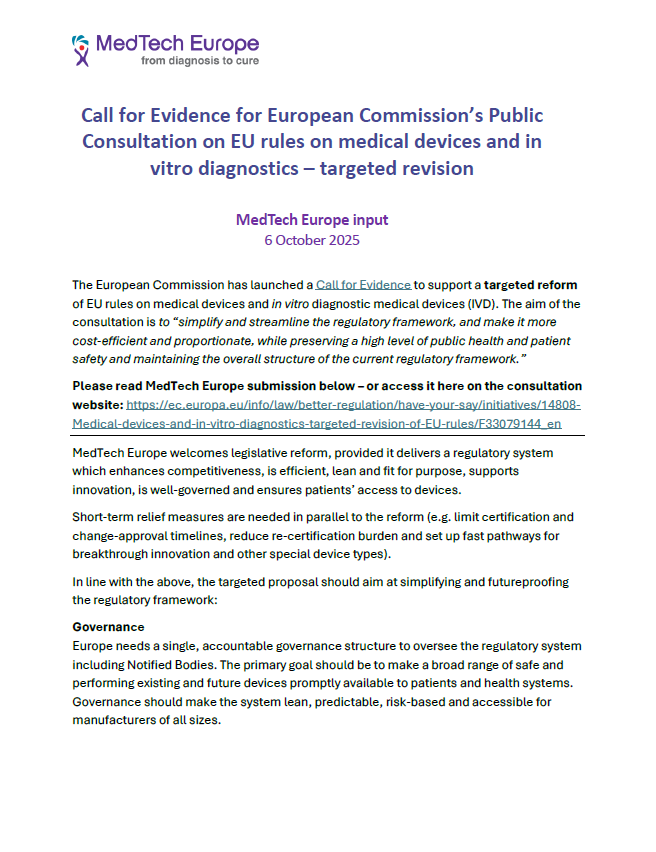
On 6 October 2025, MedTech Europe submitted a detailed response to the European Commission’s Call for Evidence on the targeted revision of the Medical Device Regulation (MDR) and In Vitro Diagnostic Regulation (IVDR). The Commission’s objective is to simplify the EU regulatory framework while ensuring high levels of safety and patient access.
Access the public consultation: https://ec.europa.eu/info/law/better-regulation/have-your-say/initiatives/14808-Medical-devices-and-in-vitro-diagnostics-targeted-revision-of-EU-rules/F33079144_en
Read MedTech Europe’s position: https://www.medtecheurope.org/new-medical-technology-regulations/the-future-of-eu-medical-technology-regulatory-system/
Strategic insights for manufacturers
MedTech Europe’s proposals focus on making the regulatory system more predictable, agile, and innovation-friendly, while reducing the burden on manufacturers and preserving safety.
1. Stronger governance
MedTech Europe calls for a single, accountable governance structure to manage the EU regulatory system—including Notified Bodies. This would support faster access to market, especially for SMEs.
2. More predictability
Key recommendations include:
Early dialogue with Notified Bodies on clinical expectations
Transparent service scope, costs, and timelines
Streamlined processes for certification and change approvals
3. Reducing the regulatory burden
The response highlights:
Clarifying roles of economic operators
Streamlining requirements for vigilance, clinical investigations, and PMS
Introducing lifecycle certification with unlimited validity unless post-market risk is identified
4. Enabling innovation
The proposal encourages:
Simplified routes for low- and medium-risk devices
Accelerated pathways for breakthrough, orphan, niche, and paediatric devices
Broader use of real-world data and literature in clinical evaluation
5. Enhancing global competitiveness
Manufacturers would benefit from:
Greater global trust in CE marking through recognition and reliance mechanisms
Digital Certificates of Free Sale
Full deployment of EUDAMED, enabling interoperability and reducing redundant data entry
6. Future alignment with other EU laws
To future-proof the framework, MedTech Europe calls for:
A single conformity assessment for MDR/IVDR and the upcoming AI Act
Alignment with GDPR, HTA, digital health, sustainability, and pharmaceutical legislation
What’s next?
The legislative proposal is expected in 2026. Manufacturers should monitor closely and begin evaluating the potential impact of these reforms on product lifecycle, certification timelines, and innovation strategies.
MedTech Europe invites industry stakeholders to remain active in shaping the future of the EU medical technology regulatory system.
Read the full document below.