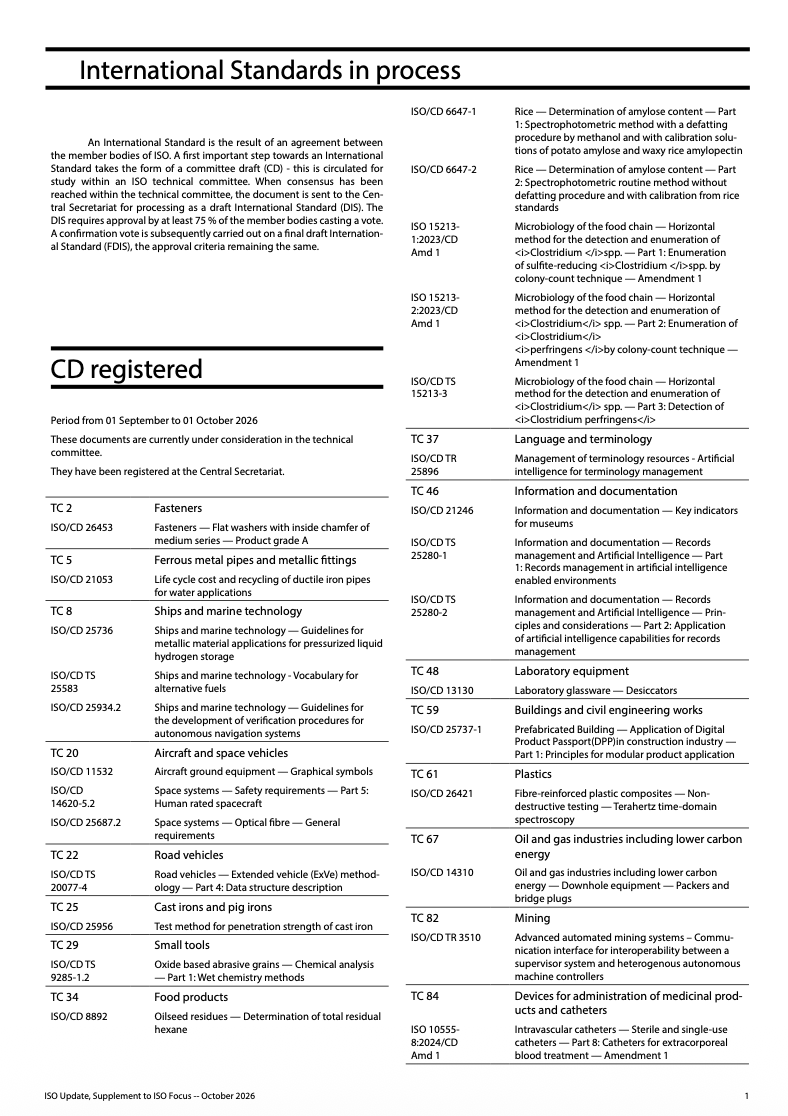
The October 2026 ISO Update provides a broad overview of standards progressing through committee draft, Draft International Standard (DIS), Final Draft International Standard (FDIS) and publication stages.
Several developments are particularly relevant to the medical device, IVD, sterilization, implant, laboratory and digital health sectors, highlighting areas where manufacturers may need to monitor future technical and regulatory expectations. 1792482601303
Intravascular Catheters
Under ISO/TC 84 — Devices for administration of medicinal products and catheters, an amendment to ISO 10555-8:2024, covering sterile, single-use catheters for extracorporeal blood treatment, has entered the Committee Draft stage.
The document is listed as:
ISO 10555-8:2024/CD Amd 1 — Intravascular catheters — Sterile and single-use catheters — Part 8: Catheters for extracorporeal blood treatment — Amendment 1. 1792482601303
Manufacturers of extracorporeal blood-treatment catheters should monitor the amendment as it progresses through the ISO development process.
Shoulder Implant Wear Testing
ISO is also developing a new standard for testing reverse shoulder prostheses.
Under ISO/TC 150 — Implants for surgery, ISO/CD 16436-2 addresses simulator wear testing for reverse total shoulder-joint prostheses. 1792482601303
The work reflects continued standardisation of preclinical mechanical and wear assessment methodologies for orthopaedic implants.
Active Implantable Medical Devices
Another important development concerns ISO 14708-1, which establishes general requirements for active implantable medical devices.
A revision has reached the DIS stage:
ISO/DIS 14708-1 — Implants for surgery — Active implantable medical devices — Part 1: General requirements for safety, marking and information to be provided by the manufacturer. 1792482601303
This revision may be particularly significant for manufacturers of devices such as implantable stimulators and other active implantable technologies, as it covers core safety, marking and manufacturer-information requirements.
Washer-Disinfectors for Thermolabile Endoscopes
Under ISO/TC 198 — Sterilization of health care products, a revision of ISO 15883-4 has reached the DIS stage.
The draft addresses:
Washer-disinfectors — Part 4: Requirements and tests for washer-disinfectors employing chemical disinfection for thermolabile endoscopes. 1792482601303
This is highly relevant for manufacturers of washer-disinfectors, endoscope reprocessing equipment and healthcare institutions involved in reusable-device reprocessing.
Ethylene Oxide Sterilization
One of the most important medical device standards listed in the update is ISO 11135.
The revision has reached the Final Draft International Standard stage:
ISO/FDIS 11135 — Sterilization of health-care products — Ethylene oxide — Requirements for the development, validation and routine control of a sterilization process for medical devices. 1792482601303
ISO 11135 is a core standard for manufacturers using ethylene oxide sterilization, and progression to FDIS signals that the revised edition is approaching final approval.
Manufacturers relying on EO sterilization should therefore monitor the final publication and assess potential impacts on:
sterilization validation;
process development;
routine control;
quality documentation;
supplier and contract sterilizer arrangements.
New Standard for Sterile Medical Device Packaging
The October update also lists the publication of ISO 11607-3:2026 under ISO/TC 198.
The new standard is titled:
“Packaging for terminally sterilized medical devices — Part 3: Requirements for process development for forming, sealing and assembly.” 1792482601303
This represents an important addition to the ISO 11607 family and introduces specific requirements relating to development of forming, sealing and assembly processes for sterile barrier systems.
For manufacturers of terminally sterilized medical devices, the new Part 3 may require review of packaging-development procedures and validation strategies.
IVD Electronic Instructions for Use
A notable new standard has also been published for IVD manufacturers.
ISO 24884:2026 — Electronic instructions for use for in vitro diagnostic medical devices — Minimum required information and means of delivery is listed among the newly published standards. 1792482601303
The standard is directly relevant to manufacturers adopting electronic instructions for use (eIFU) for IVD products.
It may support more consistent approaches to:
minimum information requirements;
electronic delivery mechanisms;
user accessibility;
digital documentation strategies.
Next Generation Sequencing Workflows
ISO is also developing standards addressing Next Generation Sequencing (NGS) in the IVD environment.
Two Draft International Standards are listed:
ISO/DIS 25379-1 — In vitro diagnostic Next Generation Sequencing workflows — Part 1: Human DNA examination;
ISO/DIS 25379-2 — In vitro diagnostic Next Generation Sequencing workflows — Part 2: Human RNA examination. 1792482601303
Both drafts are progressing under ISO/TC 212 — Medical laboratories and in vitro diagnostic systems.
These standards may become important references for manufacturers and laboratories working with genomic diagnostic workflows, particularly around standardisation of DNA and RNA examination processes.
Rapid Diagnostic Testing
Another IVD-related development is ISO/DTS 24883, which provides:
General guidance for manufacturers of lateral flow immunoassays (LFIA) for rapid diagnostic testing (RDT).1792482601303
Lateral flow devices remain widely used across infectious disease, home-testing and point-of-care applications, making this standard particularly relevant to manufacturers developing rapid diagnostic tests.
Health Informatics and Medical Device Cybersecurity
The update also includes ISO/TS 11633-1:2026, covering:
Information security management for remote maintenance of medical devices and medical information systems — Part 1: Requirements and risk analysis. 1792482601303
Remote servicing and maintenance can introduce cybersecurity and data-protection risks, particularly where devices are connected to hospital networks.
The new standard therefore provides another indication of the increasing integration of cybersecurity and information-security considerations into medical device lifecycle management.
Medical Device Interoperability
ISO also lists an FDIS concerning interoperability of health technologies:
ISO/IEEE FDIS 11073-10441 — Health informatics — Device interoperability — Part 10441: Device specialization — Cardiovascular fitness and activity monitor. 1792482601303
This development reflects broader efforts to create common interoperability frameworks for connected and digital healthcare devices.
What Manufacturers Should Monitor
The October 2026 ISO update contains standards at very different stages of development.
Manufacturers should distinguish between:
Committee Drafts (CD) — early technical committee development;
DIS — drafts submitted to ISO members for voting;
FDIS — final drafts approaching formal approval;
published International Standards — completed standards available for implementation.
ISO explains that Committee Drafts are circulated for technical committee consideration before progressing to DIS, while Final Draft International Standards undergo a final approval vote. 1792482601303
For medical device and IVD organisations, particularly relevant areas to monitor include:
sterilization;
sterile barrier packaging;
implantable devices;
catheter systems;
reprocessing equipment;
NGS;
rapid diagnostics;
IVD eIFU;
cybersecurity;
interoperability.
Impact on Medical Device and IVD Manufacturers
The October 2026 update demonstrates how rapidly the standards landscape continues to evolve across the healthcare sector.
Standards such as ISO 11135 and ISO 11607 are closely integrated into medical device quality and conformity-assessment activities, while emerging standards for NGS, eIFU, remote maintenance and diagnostic technologies reflect the growing influence of digitalisation and advanced technologies.
Manufacturers should therefore maintain an active standards-monitoring process and assess whether new or revised standards could affect:
technical documentation;
design and development;
risk management;
verification and validation;
sterilization;
packaging;
labelling and eIFU;
cybersecurity;
interoperability;
regulatory submissions.
Early assessment can help organisations identify changes before revised standards become relevant to conformity assessment or regulatory expectations.