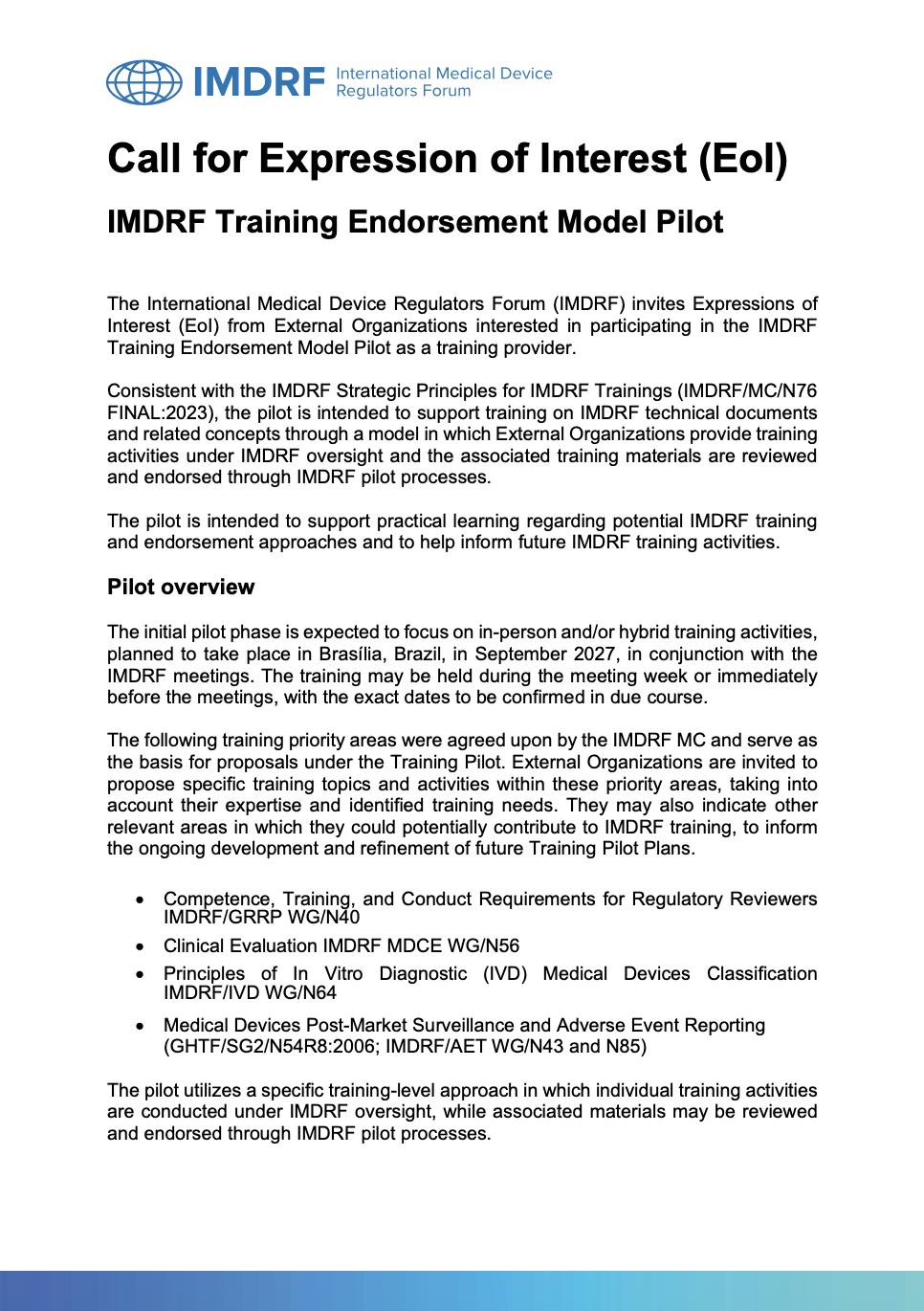
The International Medical Device Regulators Forum (IMDRF) has launched a Call for Expression of Interest (EoI)for external organisations interested in participating as training providers in its new Training Endorsement Model Pilot.
The pilot is designed to support training on IMDRF technical documents and related regulatory concepts through a model in which external organisations deliver training activities under IMDRF oversight, while associated training materials may be reviewed and endorsed through IMDRF pilot processes. 1792732292087
Pilot Planned for Brazil in 2027
The initial pilot phase is expected to focus on in-person and/or hybrid training activities in Brasília, Brazil, in September 2027, in conjunction with IMDRF meetings.
The exact dates remain to be confirmed, and the training may take place either during the meeting week or immediately before it. 1792732292087
Four Priority Training Areas
IMDRF has identified four priority areas for the pilot.
External organisations may propose specific training topics within these areas:
Competence, Training, and Conduct Requirements for Regulatory Reviewers — IMDRF/GRRP WG/N40;
Clinical Evaluation — IMDRF MDCE WG/N56;
Principles of IVD Medical Device Classification — IMDRF/IVD WG/N64;
Medical Device Post-Market Surveillance and Adverse Event Reporting — GHTF/SG2/N54R8:2006 and IMDRF/AET WG/N43 and N85. 1792732292087
Organisations may also indicate additional areas where they could contribute to future IMDRF training initiatives, although these do not expand the four priority areas for the current pilot. 1792732292087
Training-Level Endorsement Rather Than Organisation-Level Endorsement
A key feature of the pilot is that IMDRF does not endorse external organisations as entities.
Instead, the pilot focuses on training-level review, oversight and endorsement.
Individual training activities will be conducted under IMDRF oversight, while associated materials may be reviewed and endorsed through the pilot process. 1792732292087
This distinction is important for organisations considering participation, as endorsement applies to training content and activities rather than to the training provider itself.
No Financial Support From IMDRF
Participation in the pilot does not include financial support, reimbursement or funding from IMDRF.
The document states that no financial support will be provided to external organisations, speakers, reviewers, participants or other entities involved in the pilot. 1792732292087
Participation is voluntary.
Who Can Apply?
External organisations interested in becoming training providers are encouraged to apply.
Applicants should demonstrate:
experience organising and delivering training;
experience with medical device regulatory topics;
ability to coordinate with international stakeholders;
operational and logistical capability;
willingness to work with the IMDRF Management Committee, Training Oversight Subcommittee and Secretariat;
willingness to revise materials based on IMDRF review and feedback. 1792732292087
Responsibilities of the Selected Organisation
The selected organisation will be expected to work closely with the Training Oversight Subcommittee (TOSC)throughout the preparation and delivery of the pilot.
Responsibilities will include:
attending preparatory meetings;
coordinating with proposed speakers;
developing and revising training materials;
responding to TOSC review comments;
meeting the pilot timeline;
delivering training in line with endorsed materials;
contributing to pilot evaluation activities. 1792732292087
Application Deadline
Applications must be submitted using the External Organization Application Form provided in Annex II.
The submission deadline is:
15 December 2026. 1792732292087
Review and Selection Process
Applications will be reviewed by the TOSC using the evaluation criteria and rubric provided in Annex I.
The assessment process may include:
document review;
clarification requests;
meetings or interviews;
recommendation to the IMDRF Management Committee. 1792732292087
Final selection decisions will be made by the IMDRF Management Committee, with results expected by the end of March 2027. 1792732292087
Evaluation Criteria
IMDRF identifies several areas that may be considered when assessing applications.
These include:
organisational capacity;
regulatory and technical expertise;
training quality;
collaboration capability;
operational readiness;
public-interest and accessibility principles;
conflict-of-interest transparency;
logistical capability;
fee structure. 1792732292087
The evaluation rubric uses three indicative ratings:
High — fully demonstrates capability and alignment;
Medium — generally demonstrates capability, with some clarification needed;
Low — limited demonstration of capability, readiness or alignment. 1792732292087
Focus on Regulatory Training Quality
Applicants are expected to provide evidence of prior training experience.
The application template asks organisations to describe:
experience delivering regulatory training;
training provided to regulators or government agencies;
international coordination activities;
previous training programmes;
participant numbers and profiles;
training topics;
participant feedback and evaluation results. 1792732292087
This demonstrates that IMDRF is placing significant emphasis on both regulatory expertise and proven training capability.
Training Format and Speakers
The initial pilot is expected to primarily support regulator-focused training activities.
Applicants should provide:
proposed training title;
learning objectives;
format;
agenda;
proposed speakers;
speaker qualifications and expertise;
explanation of alignment with IMDRF priorities. 1792732292087
The format may be in-person or hybrid.
Public Accessibility and Training Materials
Organisations must also demonstrate their ability to support:
virtual or hybrid participation;
audiovisual requirements;
recording;
participant management;
translation or interpretation where relevant;
public availability of materials and recordings. 1792732292087
Applicants should confirm their willingness to support public availability of endorsed training materials and recordings where applicable. 1792732292087
Fee Structure
Training must be provided free of charge to IMDRF members, including:
Management Committee members;
Official Observers;
Affiliate Members;
Regional Harmonization Initiatives.
Any fee structure for non-IMDRF participants must be clearly described in the application. 1792732292087
Conflict of Interest and Transparency
Applicants must disclose:
organisational funding sources;
sponsorship arrangements;
potential conflicts of interest;
measures used to maintain independence and transparency. 1792732292087
This requirement reflects the pilot’s emphasis on credible, non-commercial regulatory education.
Indicative Timeline
The pilot timeline extends from late 2026 through early 2028.
Key milestones include:
15 December 2026 — application deadline;
January 2027 — TOSC review;
March 2027 — selection of external organisation;
15 April 2027 — revised agenda and proposed speakers;
June 2027 — Management Committee approval;
July–August 2027 — development and review of training materials;
September 2027 — delivery of pilot training in Brazil;
late 2027–early 2028 — pilot evaluation;
March 2028 — presentation of outcomes and lessons learned. 1792732292087
Impact on Regulatory Training Organisations
For organisations specialising in medical device regulatory education, this pilot represents a significant opportunity to contribute directly to the development of future IMDRF training models.
Potential applicants should assess whether they can demonstrate:
strong medical device regulatory expertise;
experience with international audiences;
high-quality instructional design;
transparent governance;
logistical readiness;
willingness to work under IMDRF review and oversight.
The pilot may also influence how IMDRF approaches external training partnerships and endorsement mechanisms in the future.
Impact on the Medical Device Regulatory Community
The initiative also signals a broader IMDRF effort to improve consistency in how its technical documents are understood and applied internationally.
By focusing on areas such as clinical evaluation, IVD classification, regulatory reviewer competence, post-market surveillance and adverse event reporting, the pilot could support more harmonised interpretation of IMDRF principles across regulatory authorities and other stakeholders.