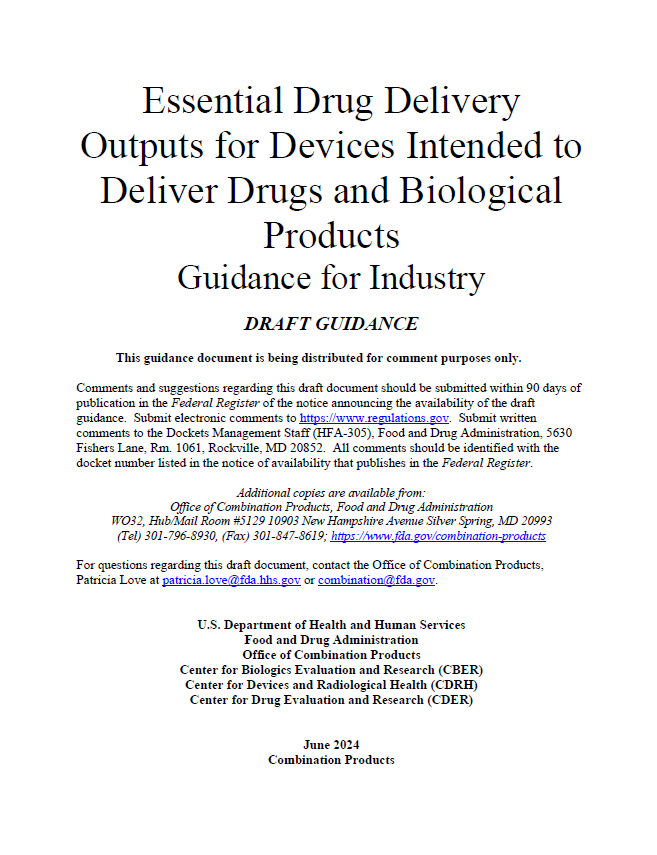
FDA Publishes Draft Guidance on Essential Drug Delivery Outputs for Drug Delivery Devices
The U.S. Food and Drug Administration (FDA) has published a draft guidance entitled “Essential Drug Delivery Outputs for Devices Intended to Deliver Drugs and Biological Products”, providing recommendations on how manufacturers should identify, verify, validate, control, and maintain device design outputs that are critical to drug delivery performance.
The guidance applies to devices and combination products intended to deliver human drugs and biological products, including prefilled syringes, autoinjectors, on-body injectors, infusion pumps, inhalers, nebulizers, nasal sprays, and vaginal delivery systems.
What are Essential Drug Delivery Outputs (EDDOs)?
FDA defines Essential Drug Delivery Outputs (EDDOs) as the design outputs necessary to ensure delivery of the intended drug dose to the intended delivery site. According to the guidance, drug delivery includes successful product preparation as well as the initiation, progression, and completion of dose delivery.
Examples of EDDOs may include:
Deliverable volume
Dose accuracy
Injection time
Activation force
Cap removal force
Flow rate accuracy
Needle extension length
Audible or visual feedback indicating dose completion
The specific EDDOs will depend on the product design and intended use.
FDA’s Recommended Approach
The draft guidance describes three key processes for managing EDDOs throughout the product lifecycle:
Identification of EDDOs;
Control of EDDOs through appropriate manufacturing and quality controls;
Maintenance of EDDOs when product or process changes occur during development or after market introduction.
FDA also provides recommendations for design verification and validation activities, including considerations for storage, shipping, shelf-life testing, and use-related conditions that may affect drug delivery performance.
Implications for Manufacturers
The draft guidance provides greater clarity on FDA’s expectations regarding the documentation and assessment of drug delivery performance.
Manufacturers of drug-device combination products and drug delivery devices should assess whether existing design control documentation adequately identifies and maintains outputs that are critical to drug delivery performance. The guidance also highlights the importance of evaluating the impact of design and manufacturing changes on established EDDOs throughout the product lifecycle.
In addition, FDA recommends that EDDO-related information be included, where applicable, in investigational submissions, marketing applications, and post-market change submissions. This includes information related to EDDO identification, verification, validation, shelf-life assessment, and control strategies.
Relationship with Existing Quality and Development Processes
The guidance notes that, for combination products, EDDOs may in some cases overlap with Critical Quality Attributes (CQAs) used in pharmaceutical development. FDA indicates that applicants may be able to leverage existing CQA information to support EDDO identification, control, and maintenance activities, where appropriate.
The document also reinforces the role of design controls in ensuring that drug delivery functions remain consistently maintained throughout the product lifecycle.
Why This Matters
Although the guidance is currently in draft form and applies to FDA-regulated products, its principles are closely aligned with established design control and lifecycle management practices already familiar to many manufacturers.
For companies developing drug-device combination products for both US and international markets, the guidance provides additional insight into FDA’s expectations for demonstrating and maintaining drug delivery performance through design controls, verification and validation activities, and change management processes.
The draft guidance is open for public comment and, once finalised, is expected to support a more consistent approach to the assessment of drug delivery performance across a broad range of devices and combination products.
Read the full draft guidance below.