FDA Issues Guidance on Cancer Clinical Trial Eligibility: Washout Periods and Concomitant Medications
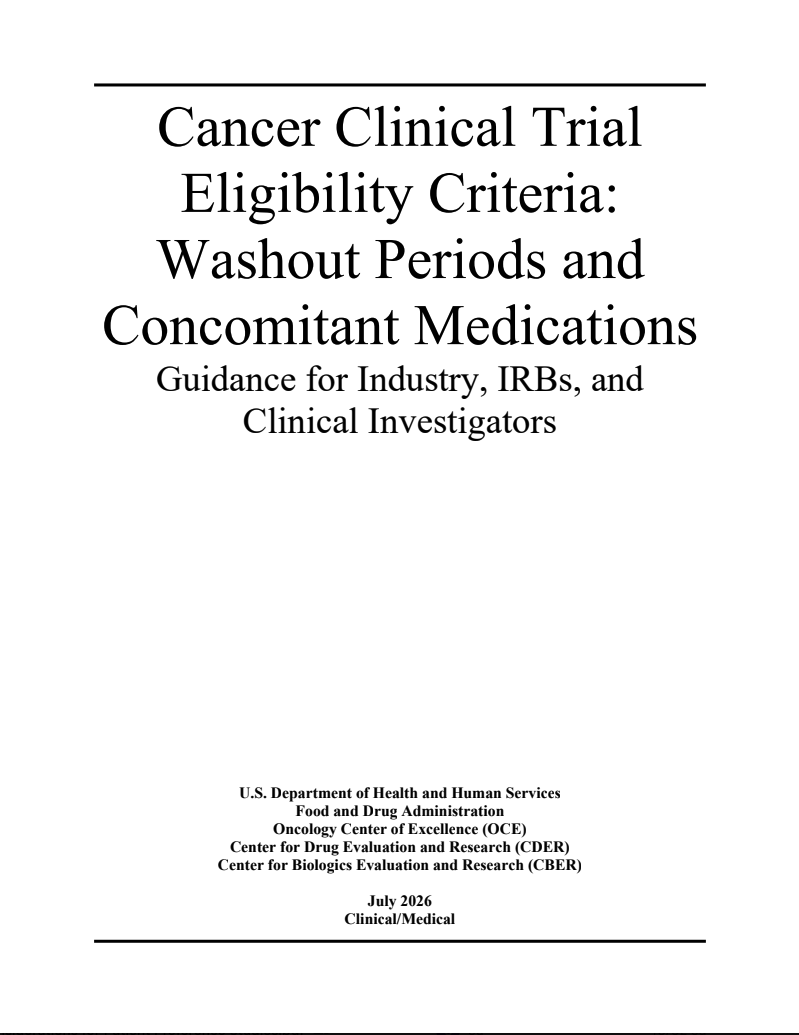
The U.S. Food and Drug Administration (FDA), through its Oncology Center of Excellence (OCE), Center for Drug Evaluation and Research (CDER), and Center for Biologics Evaluation and Research (CBER), has published final guidance titled "Cancer Clinical Trial Eligibility Criteria: Washout Periods and Concomitant Medications".
The guidance provides clinical trial sponsors, institutional review boards (IRBs), and clinical investigators with recommendations on modernizing eligibility criteria to improve participant representativeness while maintaining patient safety.
Purpose and Rationale for Modernizing Eligibility Criteria
Eligibility criteria define the patient population in clinical trials to ensure safety and evaluate therapeutic efficacy. However, historically accepted template criteria often include unnecessarily restrictive exclusion clauses.
The FDA notes that fixed washout periods and broad concomitant medication exclusions can significantly slow trial accrual, limit access for diverse patient populations, and reduce the generalizability of trial results to real-world clinical practice.
By encouraging evidence-based and risk-proportionate eligibility criteria, the FDA aims to ensure that oncology trial populations more accurately reflect the patients who will ultimately receive the therapy upon approval.
Risk-Based Washout Periods vs. Fixed Calendars
A washout period is intended to eliminate prior anticancer therapies or their residual physiological effects before initiating an investigational drug.
The updated guidance recommends shifting from arbitrary calendar-based washouts to objective clinical and laboratory parameters:
Parameter-Driven Inclusion: Sponsors are encouraged to utilize relevant laboratory values and clinical recovery metrics (e.g., return to baseline or normal limits) instead of fixed time frames (e.g., mandatory 14-day or 28-day waiting periods).
Scientific Justification: When time-based washout periods are necessary—such as when prior therapies exhibit delayed antitumor effects or prolonged toxicity—the protocol must explicitly detail the underlying PK/PD data and rationale.
Adverse Event Recovery: Candidates should be evaluated for recovery from clinically significant toxicities attributable to prior therapies rather than being subjected to routine waiting periods.
Concomitant Medication Management & Polypharmacy
Cancer patients frequently manage comorbidities requiring concomitant prescription or over-the-counter medications. The average oncology patient takes five chronic non-cancer medications, a figure that increases among elderly populations.
Broad exclusions of concomitant medications disproportionately exclude older patients and individuals with pre-existing conditions. To address this, the FDA recommends:
Targeted Exclusions: Restricting medication exclusions strictly to cases with known or predicted clinically significant drug-drug interactions (DDIs) or overlapping toxicity profiles.
Alternative Management Strategies: Utilizing dose adjustments, schedule modifications, or monitoring protocols for either the investigational drug or co-administered medication rather than automatically disqualifying participants.
Transparent Protocol Design: Documenting management strategies clearly in trial protocols and providing adequate instruction to subjects and healthcare providers.
Integrating PK/PD and Early DDI Evaluations
The FDA emphasizes that eligibility criteria should evolve dynamically across the drug development lifecycle.
As clinical knowledge expands regarding metabolism, clearance, PK/PD, and DDIs during Phase 1 and Phase 2 studies, sponsors should actively revise and relax restrictive criteria for subsequent pivotal trials.
Conducting formal DDI evaluations earlier in development allows sponsors to replace blanket prohibitions with precise dosing guidelines, optimizing enrollment timelines and trial efficiency.
Impact on Clinical Trial Sponsors and Drug Developers
For pharmaceutical companies, biotechnology sponsors, and contract research organizations (CROs) conducting FDA-regulated oncology trials, this guidance calls for a deliberate move away from historical protocol templates.
Sponsors and clinical development teams should pay particular attention to:
Re-evaluating standard protocol templates for unnecessary washout and medication exclusions;
Defining clinical and laboratory recovery benchmarks in place of fixed time-based washouts;
Documenting clear scientific justifications for any required time-based exclusion periods;
Conducting early DDI and PK/PD studies to inform risk-proportionate protocol design;
Implementing protocol-defined dose adjustment strategies for necessary concomitant drugs;
Monitoring criteria updates dynamically across trial phases as safety data accumulates.
By adopting these risk-based approaches, clinical trial sponsors can accelerate accrual, enhance trial diversity, and generate robust safety and efficacy data representative of the target patient population.