FDA Issues Draft Guidance on Premarket Submissions for Robotically-Assisted Surgical Devices
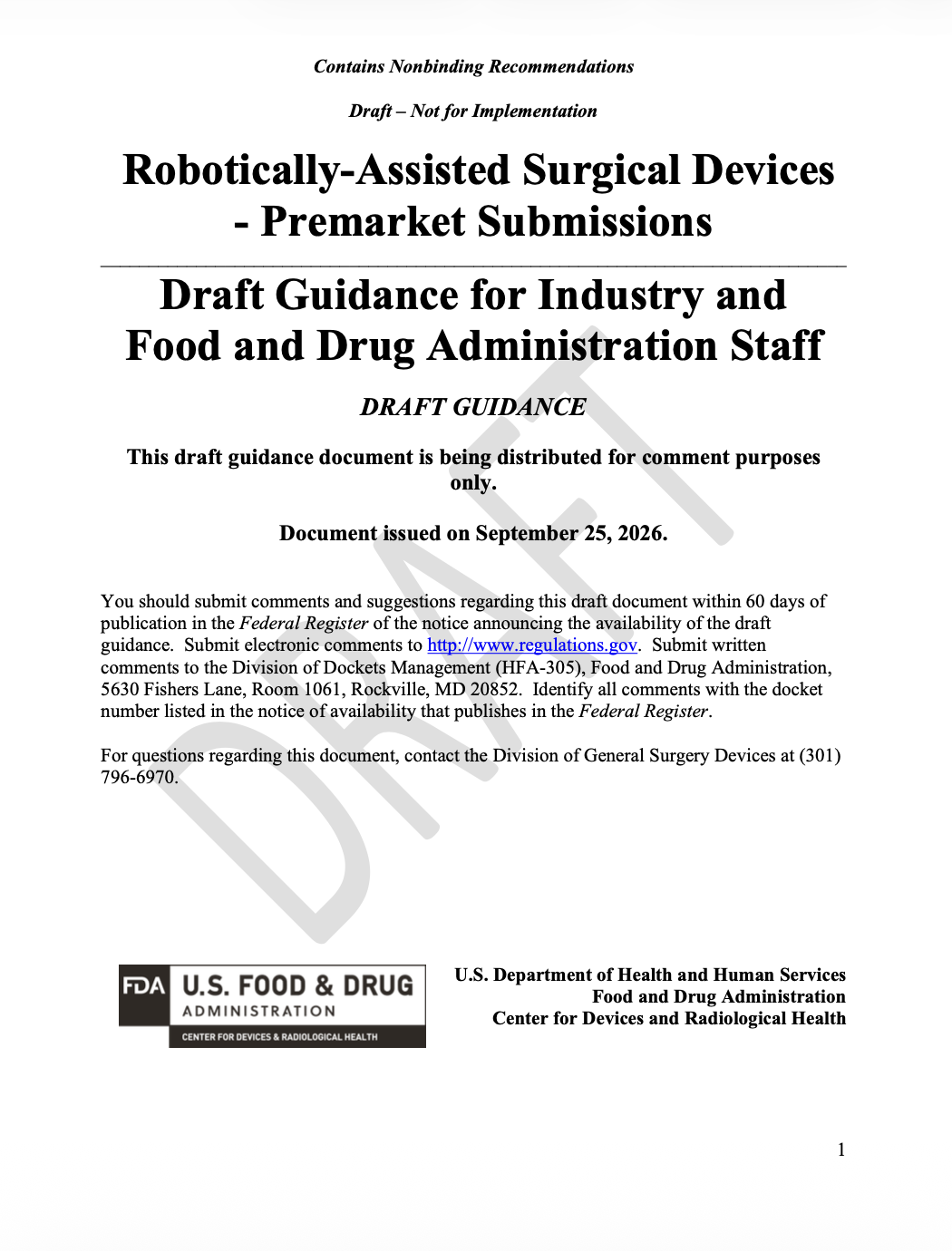
The U.S. Food and Drug Administration (FDA) has issued a new draft guidance titled “Robotically-Assisted Surgical Devices – Premarket Submissions.”
Issued on 25 September 2026, the document provides recommendations for premarket submissions involving certain robotically-assisted surgical devices (RASDs) and is open for public comment for 60 days following publication of the associated Federal Register notice. 1790342719121
What Is a Robotically-Assisted Surgical Device?
FDA describes RASDs as teleoperated, software-controlled systems that integrate robotic technologies and subassemblies to help qualified practitioners position and control surgical instruments during open, minimally invasive or endoluminal procedures.
These systems remain under the direct control or supervision of a qualified practitioner and may include automated functions intended to enhance user capabilities. 1790342719121
RASDs generally include three major subassemblies:
an operator or surgeon console;
a bedside/patient subassembly containing working arms and surgical instruments;
an operating room staff subassembly containing supporting hardware and software. 17903427191211790342719121
Scope of the Draft Guidance
The guidance applies to premarket submissions for certain RASDs.
FDA specifically excludes several technologies from its scope, including:
pre-operative planning systems;
stereotaxic systems;
systems intended to assist with certain interventional devices;
remotely teleoperated RASDs;
autonomous robotic systems that independently perform significant operative tasks. 17903427191211790342719121
For devices falling outside the scope, FDA strongly recommends early engagement through the Q-Submission Program. 1790342719121
Detailed Device Description
FDA recommends that premarket submissions provide a clear description of the complete robotic system before moving into individual components and subassemblies.
Information should address areas such as:
overall system configuration;
principle of operation;
kinematic diagrams;
connections between subassemblies;
data transmission;
operator console;
robotic working arms;
surgical instruments;
cameras;
safety features;
compatible accessories and third-party devices. 1790342719121
FDA also notes that videos demonstrating the device user interface and novel technological functions may help explain complex robotic systems. 1790342719121
Predicate Comparison for 510(k) Submissions
For RASDs submitted through the 510(k) pathway, manufacturers must compare the new device with a legally marketed predicate to support substantial equivalence.
FDA recommends detailed side-by-side comparison of relevant technological characteristics and cautions that terms such as “identical” or “same” should only be used where the features are demonstrably identical.
Any technological differences should be explained together with evidence showing why they do not raise different questions of safety or effectiveness. 1790342719121
Accessories and Compatible Devices
Accessories and compatible devices — including third-party products — should be clearly identified in the submission and in the proposed labeling.
Manufacturers should demonstrate compatibility and interoperability through performance testing and should evaluate the complete RASD configuration, including relevant adapters, drapes, accessories and connected equipment. 1790342719121
RASD-Specific Non-Clinical Performance Testing
A major part of the draft guidance is dedicated to non-clinical performance testing.
FDA expects testing to comprehensively assess system-level characteristics critical to safe and effective use, including:
teleoperation;
system controls;
kinematics and dynamics;
visualization systems;
additional robotic features;
reliability. 1790342719121
Testing may include in vitro, in silico, ex vivo, cadaver, mechanical, electrical, thermal, radiation and functional testing.
FDA recommends testing both individual subassemblies and the complete system under representative and worst-case conditions. 1790342719121
System Latency and Teleoperation
Because RASDs rely on teleoperation, FDA places particular emphasis on signal integrity and system latency.
Testing should assess the delay between:
surgeon hand input;
robotic instrument response;
corresponding visual feedback.
FDA recommends evaluating latency under representative and worst-case loads and, generally, testing a minimum of three RASDs, unless a smaller sample size is scientifically justified. 1790342719121
Motion Scaling and Tremor Reduction
RASDs may include functions such as:
motion scaling;
tremor filtering;
motion smoothing;
force modulation;
haptic filtering.
FDA recommends characterising these functions through objective testing to demonstrate that operator inputs are transformed in a consistent, predictable and controlled manner. 1790342719121
System Controls and Emergency Recovery
The guidance also focuses on the safety of complex integrated control systems.
FDA recommends testing to demonstrate that the RASD:
remains stable during disturbances;
detects and responds to faults;
activates safety stops appropriately;
supports controlled recovery;
enables rapid emergency access to the patient. 1790342719121
Emergency removal testing should evaluate the time required to remove relevant robotic components and confirm that the system does not introduce unacceptable delays during time-critical situations. 1790342719121
Emergency and Safety Stops
Safety stop mechanisms should be evaluated under both normal and fault conditions.
FDA expects testing to demonstrate that activation stops motion and active instrument functions within defined safe limits without causing additional unintended movement. 1790342719121
Kinematics and Dynamics
FDA recommends detailed assessment of the robotic system’s motion characteristics.
Relevant parameters include:
positional accuracy;
repeatability;
resolution;
reachable workspace;
range of motion;
velocity limits;
position tracking;
collision detection and avoidance;
singularity management;
physical stability. 1790342719121
Accuracy, repeatability and resolution should be evaluated independently for translational and rotational motion. 1790342719121
Workspace and Patient Anatomy
Workspace testing should demonstrate that robotic arms can safely reach the intended anatomy while avoiding collisions with the patient, operating room staff and other equipment.
FDA also recommends validating reachability across the intended patient population, including clinically relevant variations in:
body mass index;
anatomy;
patient positioning. 1790342719121
Collision and Singularity Risks
The guidance specifically addresses collision hazards and robotic singularities.
Manufacturers should identify singularity points within the robotic system and demonstrate how the design prevents or mitigates unexpected instrument motion caused by singularities, software failures, electromagnetic interference or other faults. 1790342719121
Visualization Systems
The visualization system is considered essential to the safe use of a RASD.
Testing should address:
image resolution;
distortion;
field of view;
depth of field;
colour rendition;
thermal safety;
performance during electromagnetic disturbances. 1790342719121
AI/ML and Additional Robotic Features
FDA also addresses additional capabilities such as:
eye tracking;
haptic feedback;
integration of X-ray or MRI;
artificial intelligence and machine learning;
image segmentation;
instrument tracking;
critical structure identification.
FDA recommends a dedicated risk assessment and performance testing strategy for these features, with redundancy and fail-safe design considered for critical functions. 1790342719121
For AI-enabled functions, FDA encourages manufacturers to engage through the Q-Submission Program and notes that a Predetermined Change Control Plan (PCCP) may be appropriate for anticipated post-authorisation software changes. 1790342719121
Reliability Testing
Reliability testing should demonstrate that the entire RASD — including hardware, software, instruments and mechanical components — continues to operate safely throughout its expected service life.
FDA discusses concepts such as:
mean time between failures;
mean time to failure;
B10 reliability;
worst-case cyclic loading;
instrument fatigue;
repeated grasping and cutting;
reusable instrument reprocessing. 1790342719121
For certain grip and cutting reliability tests, FDA recommends sample sizes sufficient to demonstrate 95% reliability with 95% confidence. 1790342719121
Software Documentation
FDA considers software central to RASD safety and effectiveness.
The draft states that device software functions for RASDs will generally warrant an “Enhanced” Documentation Levelunder FDA's software submission guidance.
Manufacturers proposing a Basic Documentation Level should provide a scientific justification based on the risks associated with the software functions. 1790342719121
Software verification and validation should cover:
unit testing;
integration testing;
full-system testing;
safety notifications;
fault handling;
regression testing;
software change impact analysis. 1790342719121
Cybersecurity
The draft contains specific recommendations for cybersecurity because RASDs may connect to networks, servers, databases, cloud platforms and other devices.
Where a RASD meets the statutory definition of a cyber device, its submission must comply with applicable FDA cybersecurity requirements. 1790342719121
FDA further recommends that cybersecurity assessments address:
system assets;
threats and vulnerabilities;
exploitability;
accessories and connected devices;
all robotic subassemblies;
hospital networks;
back-end infrastructure;
cloud services;
remote access;
teleoperation;
system updates.
Penetration testing should account for the full connected ecosystem, including scenarios where the RASD communicates with a compromised hospital network. 1790342719121
Wireless Technology
Where wireless communication is used, manufacturers should address reliable, timely and secure transmission and consider applicable standards for wireless coexistence and risk management. 1790342719121
Training
FDA stresses that the safety and effectiveness of surgical robotic systems depend heavily on user competency.
Manufacturers should establish and validate training programmes not only for surgeons, but also for other relevant operating-room personnel, including:
bedside assistants;
surgical scrub nurses;
other staff interacting with the RASD. 1790342719121
Training may combine didactic education, surgical simulators, bench exercises, animal models and cadaver-based experience. 1790342719121
Human Factors and Usability
Human factors evaluation should begin early in development and continue iteratively throughout design.
FDA recommends validation under realistic operating-room conditions, with representative users and, where appropriate, multidisciplinary teams using the system simultaneously. 1790342719121 1790342719121
Human factors studies should consider hazards associated with:
surgical planning;
instrument preparation;
reprocessing;
instrument exchange;
emergency procedures;
communication between surgeons and staff;
experience with other robotic systems;
potential negative knowledge transfer. 1790342719121
Electrical Safety and EMC
RASDs should be evaluated for electrical safety and electromagnetic compatibility.
FDA references standards including:
ANSI/AAMI ES60601-1;
ANSI/AAMI/IEC 60601-1-2;
IEC 80601-2-77 for robotically-assisted surgical equipment. 1790342719121 1790342719121
Sterility and Reprocessing
Where components enter the sterile field, manufacturers should provide appropriate sterilisation information and validation.
For sterile devices, FDA generally recommends a sterility assurance level of 10⁻⁶, except where devices contact only intact skin. 1790342719121
Reusable robotic components should also have validated cleaning, disinfection and sterilisation instructions.
FDA highlights particular challenges for components with small lumens or difficult-to-reach surfaces and recommends demonstrating continued device performance following repeated reprocessing. 1790342719121
Biocompatibility
Manufacturers should evaluate all direct and indirect patient-contacting materials according to applicable biological risk.
Depending on the contact type, relevant endpoints may include:
cytotoxicity;
sensitisation;
irritation;
systemic toxicity;
material-mediated pyrogenicity;
hemocompatibility;
genotoxicity. 1790342719121 1790342719121
In Vivo Evaluation
FDA explains that in vivo evidence may include both non-clinical and clinical data.
Clinical evidence may be needed for:
new RASDs;
new indications;
use in special populations;
significant technological changes;
unresolved questions from non-clinical testing;
superiority or disease-specific claims. 1790342719121 1790342719121
Clinical Study Endpoints
For relevant RASD clinical investigations, FDA identifies several commonly useful surgical outcomes, including:
hospital length of stay;
intraoperative adverse events;
estimated blood loss and transfusion;
conversion rate;
postoperative adverse events;
readmissions;
reoperations;
mortality;
operative time. 1790342719121
The Agency also provides procedure-specific endpoints for particular surgical applications. 1790342719121
Real-World Evidence and Clinical Literature
The draft recognises that real-world data and real-world evidence may support regulatory decision-making where the data are sufficiently relevant and reliable. 1790342719121
Clinical literature may also support submissions, including as a comparator or as evidence supporting expansion of authorised uses.
Umbrella and Covered Procedure Approach
Another important concept in the guidance is the umbrella and covered procedure paradigm.
FDA defines an umbrella procedure as a surgical procedure of sufficient complexity and risk that its performance data may support authorisation of related procedures with lower complexity and risk. 1790342719121
This approach may help manufacturers support multiple procedures without generating completely independent datasets for every individual indication where scientific justification supports extrapolation.
Impact on Robotically-Assisted Surgical Device Manufacturers
For surgical robotics manufacturers and regulatory teams preparing U.S. submissions, the draft guidance significantly clarifies FDA expectations across the entire evidence package.
Stakeholders should pay particular attention to:
system-level device descriptions;
510(k) predicate comparisons;
accessory interoperability;
latency and teleoperation testing;
kinematic and dynamic performance;
emergency recovery;
reliability;
software documentation;
cybersecurity;
AI/ML features and PCCPs;
training;
human factors;
sterilisation and reprocessing;
biocompatibility;
clinical evidence;
RWE;
umbrella and covered procedure strategies.
The broader message is that FDA expects RASD submissions to treat surgical robots as integrated systems, with evidence addressing not only individual components but also the interaction between hardware, software, users, accessories, networks and the clinical environment.
Comment Period
The draft guidance is currently open for public comment.
FDA requests comments and suggestions within 60 days of publication of the Federal Register notice announcing availability of the document.