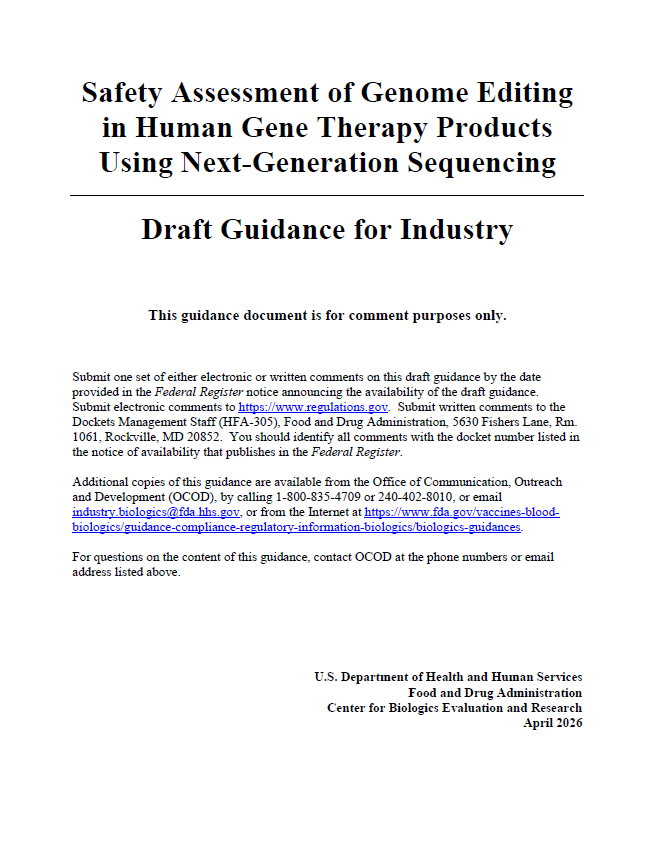
In April 2026, the U.S. Food and Drug Administration (FDA) released a draft guidance outlining its current thinking on the use of next-generation sequencing (NGS) to assess safety risks in human gene therapy products incorporating genome editing (GE) technologies.
The document provides non-binding recommendations for sponsors developing genome editing therapies, particularly in support of Investigational New Drug (IND) and Biologics License Applications (BLA).
Scope and Context
The guidance applies to human gene therapy products using genome editing technologies, including those targeting the genome, epigenome, or transcriptome.
It builds on the FDA’s January 2024 guidance on genome editing therapies, with a specific focus on nonclinical safety assessment using NGS and bioinformatics tools.
A central theme is the need to evaluate risks such as:
Off-target editing activity
Unintended genomic alterations
Loss of chromosomal integrity
Key Technical Expectations
1. Use of NGS in Nonclinical Studies
The FDA recommends the use of NGS-based methods to support clinical trial initiation, enabling:
Detection of low-frequency off-target events
Quantitative analysis of on-target and off-target edits
Assessment of genome-wide changes
Sponsors are expected to justify:
Sequencing strategy (short-read vs long-read)
Sequencing depth and sensitivity
Bioinformatics pipelines and analysis parameters
2. On-Target Editing Assessment
Manufacturers should:
Quantify on-target editing rates
Report both intended and unintended edits at the target site
Ensure test conditions reflect final product performance
3. Off-Target Risk Assessment
The guidance provides a structured approach combining:
Cell-based assays
Biochemical assays
In silico methods
Sponsors are encouraged to:
Use multiple complementary approaches
Perform studies in relevant human cell types
Include biological replicates
Confirm identified off-target sites using targeted sequencing methods
Detailed reporting is expected, including:
Genomic location and annotation
Editing frequencies
Functional relevance (e.g. gene impact)
4. Consideration of Human Genetic Variability
A notable element is the requirement to assess how genetic variation across populations may influence off-target risks.
This includes:
Use of genomic databases
Evaluation of variant-driven off-target sites
Consideration of population stratification and allele frequency
5. Chromosomal Integrity and Translocations
For editing approaches involving double-strand breaks, sponsors should assess:
Chromosomal translocations
Genome integrity using NGS-based methods
6. Regulatory Submission Expectations
The FDA expects that:
Off-target and chromosomal integrity studies are completed prior to IND submission
Detailed reports are included in regulatory submissions
Sponsors engage early via INTERACT or pre-IND meetings
What This Means for Manufacturers
This draft guidance reinforces several important trends:
Increased regulatory expectations for genomic safety data, particularly for advanced therapies
Greater reliance on NGS and bioinformatics capabilities
Need for robust, well-justified study designs and methodologies
Higher documentation and reporting standards
Manufacturers developing genome editing therapies should ensure that their nonclinical development programs are aligned with these expectations, particularly in relation to off-target risk characterization and sequencing strategies.
Early interaction with the FDA is clearly encouraged to de-risk development and align on study approaches.
Next Steps
As this is a draft guidance, stakeholders have the opportunity to submit comments before finalization.
Read the full document below.