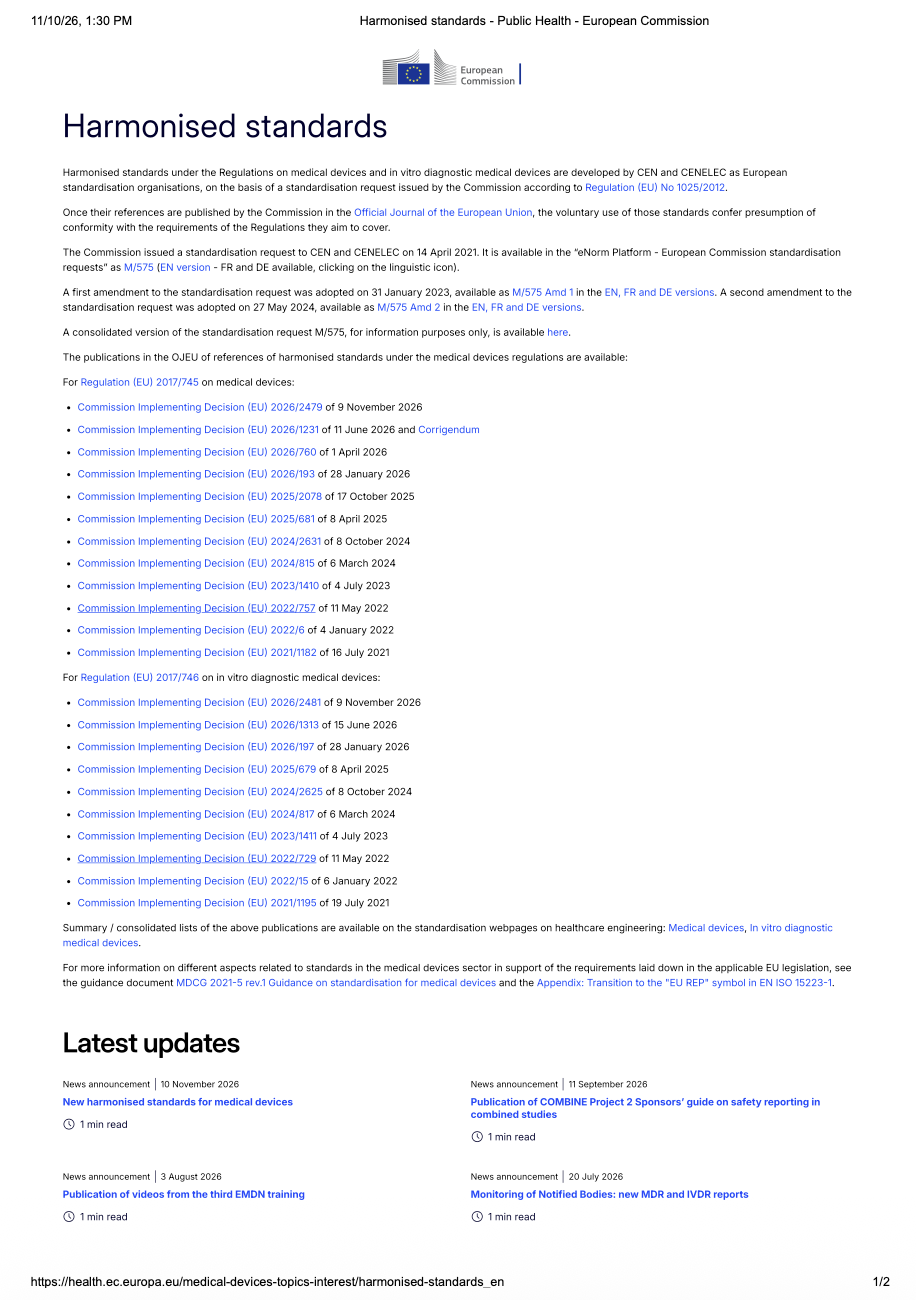
The European Commission has updated its harmonised standards framework for medical devices and in vitro diagnostic medical devices, adding new implementing decisions under both Regulation (EU) 2017/745 (MDR) and Regulation (EU) 2017/746 (IVDR).
The update reflects the publication of Commission Implementing Decision (EU) 2026/2479 for medical devices and Commission Implementing Decision (EU) 2026/2481 for IVDs, both dated 9 November 2026.
Why Harmonised Standards Matter
Harmonised standards under the MDR and IVDR are developed by CEN and CENELEC, the European standardisation organisations, following a formal standardisation request from the European Commission.
Once references to those standards are published in the Official Journal of the European Union (OJEU), their voluntary use can provide a presumption of conformity with the relevant requirements of the applicable Regulation.
For manufacturers, this makes harmonised standards an important regulatory tool for demonstrating compliance with applicable MDR and IVDR requirements.
New MDR Implementing Decision
For Regulation (EU) 2017/745 on medical devices, the Commission now lists:
Commission Implementing Decision (EU) 2026/2479 of 9 November 2026.
This becomes the latest implementing decision in the MDR harmonised standards framework.
Previous 2026 decisions listed by the Commission include:
Decision (EU) 2026/1231 of 11 June 2026, together with its corrigendum;
Decision (EU) 2026/760 of 1 April 2026;
Decision (EU) 2026/193 of 28 January 2026.
New IVDR Implementing Decision
The Commission has also updated the harmonised standards framework under Regulation (EU) 2017/746.
The latest listed decision is:
Commission Implementing Decision (EU) 2026/2481 of 9 November 2026.
Other IVDR decisions published during 2026 include:
Decision (EU) 2026/1313 of 15 June 2026;
Decision (EU) 2026/197 of 28 January 2026.
Standardisation Request M/575
The current harmonisation work originates from the European Commission’s standardisation request M/575, issued to CEN and CENELEC on 14 April 2021.
The request has subsequently been amended.
The Commission lists:
M/575;
M/575 Amendment 1, adopted on 31 January 2023;
M/575 Amendment 2, adopted on 27 May 2024.
A consolidated version of the standardisation request is also available for information purposes.
Presumption of Conformity
One of the most important regulatory benefits of harmonised standards is the possibility of relying on presumption of conformity.
Where a manufacturer voluntarily applies a harmonised standard whose reference has been published in the OJEU, compliance with that standard can support demonstration of conformity with the regulatory requirements it is intended to cover.
This can be particularly relevant when preparing:
technical documentation;
General Safety and Performance Requirements checklists;
risk management documentation;
verification and validation evidence;
conformity assessment submissions.
Voluntary Use Remains the Principle
Harmonised standards remain voluntary.
Manufacturers are not legally required to use them if they can demonstrate compliance with MDR or IVDR requirements using another appropriate technical solution.
However, where applicable, harmonised standards can offer a more predictable and widely recognised route for demonstrating conformity.
Impact on Medical Device Manufacturers
Manufacturers should review the new November 2026 decisions to determine whether any newly harmonised or revised standards apply to their devices.
Key actions may include:
reviewing the newly published OJEU references;
identifying standards relevant to the product portfolio;
comparing current technical documentation against new editions;
assessing whether transition periods apply;
updating GSPR mappings;
evaluating potential impacts on verification and validation activities;
reviewing quality management system procedures.
Impact on IVD Manufacturers
For IVD manufacturers, the publication of Decision (EU) 2026/2481 should trigger a similar review.
Teams should determine whether newly referenced standards affect:
analytical performance;
clinical performance;
risk management;
usability;
software;
biological safety;
labelling;
quality systems.
The relevance will depend on the specific standards included in the new OJEU publication.
Notified Bodies and Harmonised Standards
Notified Bodies also rely on harmonised standards when evaluating how manufacturers demonstrate compliance with applicable MDR and IVDR requirements.
Although alternative approaches remain possible, deviations from harmonised standards may require additional technical justification.
Manufacturers should therefore ensure that any decision not to follow an applicable harmonised standard is appropriately documented and scientifically justified.
Consolidated Lists Remain Available
The European Commission also maintains summary and consolidated lists of harmonised standards through its healthcare engineering standardisation webpages for:
medical devices;
in vitro diagnostic medical devices.
These consolidated resources can help regulatory and quality teams monitor changes over time.
MDCG Guidance on Standardisation
The Commission also points manufacturers to MDCG 2021-5 rev.1 — Guidance on standardisation for medical devices, together with its appendix relating to the transition to the “EU REP” symbol in EN ISO 15223-1.
This guidance provides additional context on how standards interact with the MDR and IVDR regulatory framework.
Regulatory Monitoring Is Essential
The new November 2026 decisions reinforce the importance of maintaining an active standards surveillance process.
Manufacturers should not rely exclusively on the standards that were applicable when a device was initially certified.
Standardisation evolves continuously, and new OJEU publications may affect:
regulatory strategy;
technical documentation;
product testing;
risk management;
conformity assessment.
Impact on Regulatory and Quality Teams
Regulatory and quality teams should establish a systematic process to monitor:
new harmonised standards;
revisions to existing standards;
withdrawals;
transition dates;
OJEU publication status;
changes to standardisation requests.
This is particularly important for manufacturers managing large device portfolios or multiple product generations.
New November 2026 Update
The Commission’s harmonised standards webpage identifies “New harmonised standards for medical devices” as a latest update dated 10 November 2026.
This update follows the publication of the two new implementing decisions on 9 November and confirms continued development of the harmonised standards framework supporting MDR and IVDR implementation.