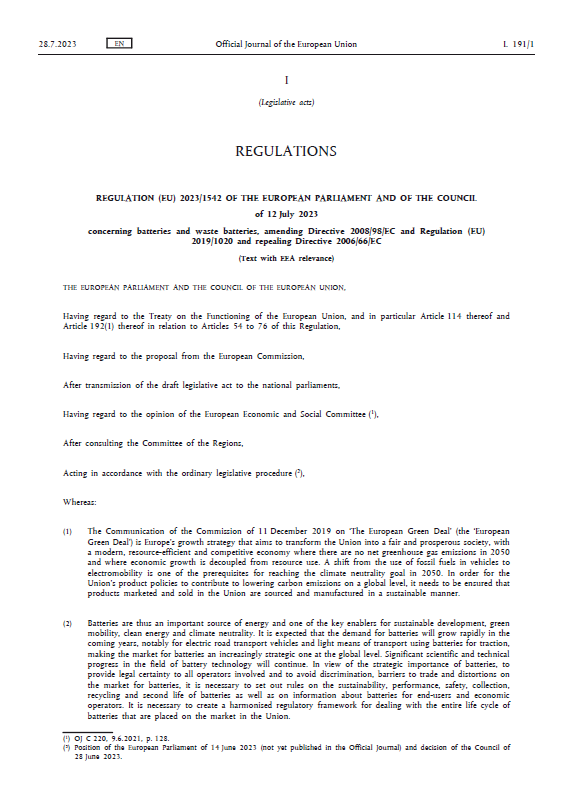
The EU Batteries Regulation (EU) 2023/1542, adopted on 12 July 2023 and published in the Official Journal on 28 July 2023, establishes a harmonised framework governing batteries throughout their lifecycle within the European Union.
The Regulation repeals Directive 2006/66/EC and introduces requirements relating to sustainability, safety, labelling, conformity assessment, and end-of-life management of batteries.
While the Regulation has been in force since 2023, a number of provisions apply progressively over time.
Scope
The Regulation applies to all categories of batteries, including:
Portable batteries
Starting, lighting and ignition (SLI) batteries
Light means of transport (LMT) batteries
Electric vehicle batteries
Industrial batteries
It also applies to batteries incorporated into products or supplied together with products, regardless of whether they are placed on the market individually or as part of another device.
Key Regulatory Elements
Sustainability and Safety Requirements
Batteries may only be placed on the market or put into service if they meet applicable sustainability and safety requirements, as well as labelling and information requirements set out in the Regulation.
Carbon Footprint Declarations
The Regulation requires that carbon footprint declarations be established for certain battery categories, including:
Electric vehicle batteries
Rechargeable industrial batteries (above 2 kWh)
Light means of transport batteries
These requirements apply from different dates depending on the battery type, beginning from 2025 onwards.
Labelling and Information
Batteries must be accompanied by clear and reliable information, including labelling and digital access (e.g. via QR codes) to relevant data concerning their characteristics and lifecycle.
Due Diligence Obligations
Economic operators placing batteries on the market are required to establish due diligence policies addressing social and environmental risks linked to the sourcing and processing of raw materials used in battery manufacturing.
End-of-Life Management
The Regulation establishes requirements for:
Collection of waste batteries
Recycling and recovery of materials
Extended producer responsibility (EPR)
Producers are responsible for financing and organising the management of waste batteries.
Considerations for Manufacturers
Manufacturers placing products on the EU market that include batteries may need to consider:
Whether their products fall within the scope due to incorporated batteries
The availability of technical information required under the Regulation
Alignment of supply chain practices with due diligence requirements
Potential implications for product design, labelling, and documentation
The Regulation defines “economic operators” broadly, including manufacturers, importers, and distributors involved in placing batteries on the market.
Timeline
The Regulation provides for phased application of requirements. For example:
Carbon footprint declaration obligations apply from 2025–2030, depending on battery category
Directive 2006/66/EC is repealed from 18 August 2025, with certain transitional provisions
Conclusion
Regulation (EU) 2023/1542 introduces a comprehensive and harmonised framework for batteries in the EU. As implementation progresses, economic operators placing batteries on the market, including those incorporated into products, should review applicable requirements and timelines to ensure continued compliance.
Read the full document below.