UK Health Bill Proposes New Medical Device Licensing Regime for Great Britain
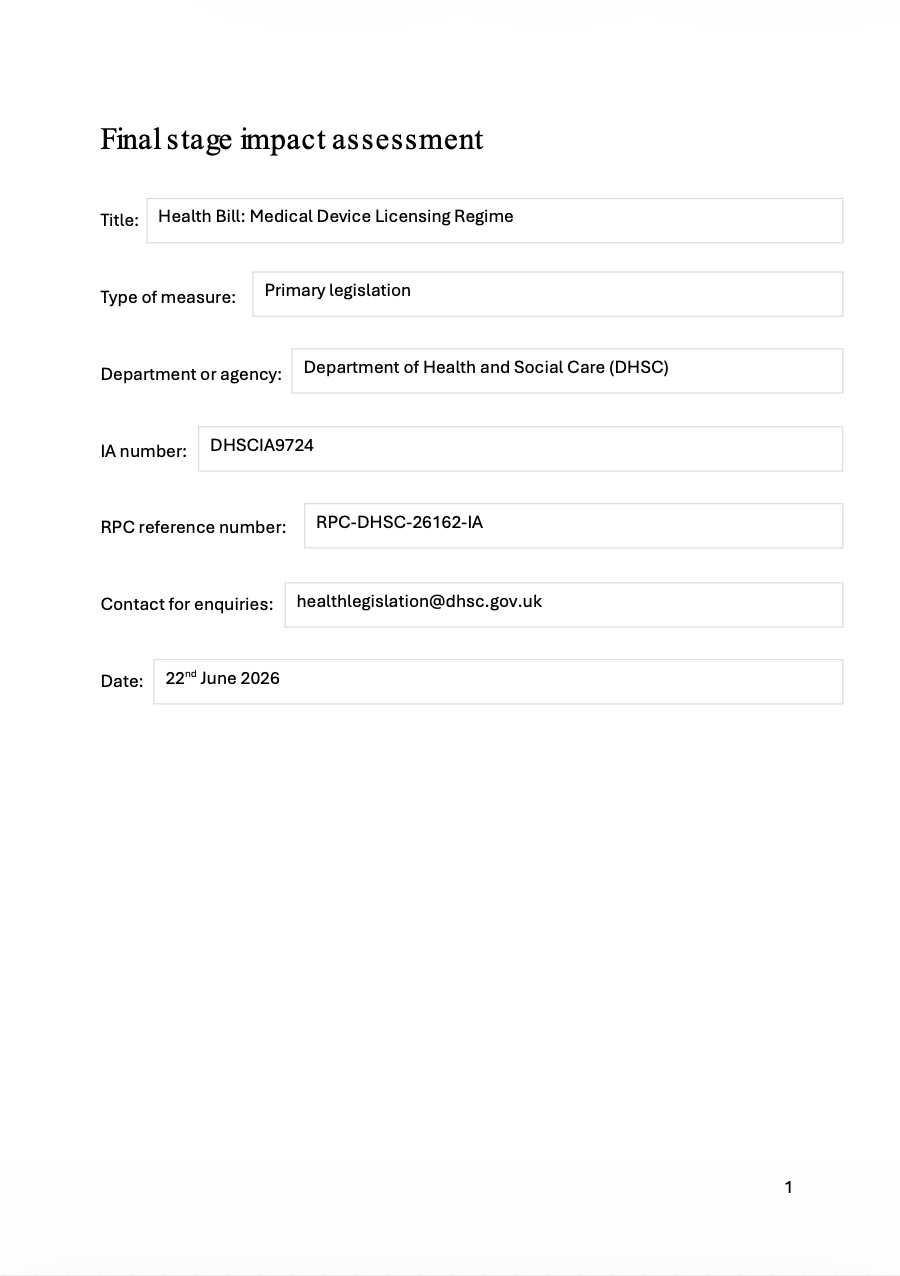
The Department of Health and Social Care, DHSC, has published a Final Stage Impact Assessment for the Health Bill: Medical Device Licensing Regime.
The assessment is dated 22 June 2026 and concerns primary legislation that would introduce enabling powers for a future medical device licensing regime.
Summary of the Proposal
The Health Bill 2026 proposes new primary legislative powers to allow the Secretary of State for Health and Social Care to establish, through later secondary legislation, a medical device licensing regime.
The proposal is intended to ensure that Great Britain maintains a safe, effective and sustainable system for allowing medical devices onto the market, while also supporting innovation and growth.
The document explains that medical devices in Great Britain are currently regulated through a combination of the domestic UKCA route and time-limited recognition of CE-marked devices.
Rationale for Change
According to the assessment, the introduction of international reliance and recognition pathways could reduce demand for domestic approvals and raise questions about the long-term sustainability of the current domestic model.
The current model depends on third-party UK Approved Bodies, UKABs, to carry out conformity assessments for all but the lowest-risk medical devices.
The document states that, without intervention, there is a risk that the domestic route becomes progressively less used, reducing the UK’s ability to maintain independent regulatory expertise, respond flexibly to new technologies or public health needs, and maintain international influence.
Proposed Role of MHRA
The assessment states that the MHRA does not currently have powers to undertake device assessments and authorise devices directly.
The proposal is therefore to grant new licensing powers, delivered through the MHRA as the medical device regulator and future licensing authority.
Under a future licensing regime, the MHRA would be responsible for decisions and able to license devices directly based on its own in-house assessments. The regime could also allow the MHRA to draw on external technical or scientific expertise through subcontracted assessment activity or specialist advisory support.
Territorial Scope
The impact assessment explains that the proposed future medical device licensing regime would apply to the Great Britain market, covering England, Scotland and Wales.
Under the Windsor Framework, medical devices placed on the Northern Ireland market must comply with relevant EU medical device legislation.
Policy Aims
The policy aims include strengthening resilience and maintaining a sustainable domestic route to market for medical devices in Great Britain.
The assessment also identifies aims such as preserving UK regulatory capability, supporting innovation and growth in the UK medical technology sector, enabling greater regulatory flexibility, maintaining high standards of patient safety and supporting the UK’s international regulatory influence.
Current Market Context
The document states that UKCA-marked medical devices currently account for approximately 7% of the Great Britain market, with the remaining 93% coming from recognition of CE-marked devices.
It also states that around 450,000 medical devices on the Great Britain market are UKCA-marked.
The impact assessment notes that international reliance or recognition routes are also existing or upcoming, including proposed reliance on approvals or certificates from Australia, Canada and the USA, and consultation on indefinite recognition of CE-marked devices.
Issues With the Current Model
The assessment identifies declining demand for domestic approvals as a key issue.
It states that potential indefinite recognition of CE-marked medical devices and international reliance pathways have reduced incentives for manufacturers to seek UKCA certification. Manufacturers have also criticised the UKAB model as duplicative, costly, time-consuming and lacking transparency.
The document also notes concerns around the commercial viability of UKABs. Since 2025, two UKABs have decided to withdraw their designation and cease operations, leaving nine UKABs in the market, with a material risk of further withdrawals in the next three to five years.
Innovation and Flexibility
The assessment states that the current UKAB-based model lacks flexibility to support innovation.
It explains that the current Medical Devices Regulations 2002 are highly prescriptive, which can limit proportionate application of requirements for novel, iterative or hard-to-classify technologies.
The document states that authorising products in-house would allow the MHRA to take liability for the decision, enabling more flexible application of regulations to support innovation in areas of unmet clinical need or healthcare system priorities.
Conditional Licensing
The future regime could allow flexible approaches such as conditional licensing.
The assessment describes this as time-limited or evidence-generating licences for devices that show early promise but do not yet have a full evidence base. This would support earlier patient access while additional data is collected, with regulatory oversight and patient safety maintained.
The document also explains that conditional licensing could include conditions, restrictions or ongoing obligations, such as enhanced post-market surveillance, restriction to particular patient groups or clinical settings, or further data requirements on safety, performance or long-term outcomes.
Preferred Option
The impact assessment considers several policy options, including business-as-usual, reform of the UKCA and UKAB model, expanded MHRA roles and a medical device licensing power.
The Government identifies Option 2 — Medical Device Licensing Power as the preferred option.
The preferred option is considered to address the structural issues more comprehensively than alternatives, including declining demand for UKCA certification, UKAB viability risks and the need for a more flexible and resilient regulatory system.
Costs and Benefits
The assessment states that most costs and benefits cannot be fully quantified at this stage because the current proposal concerns enabling powers, with practical changes to be delivered later through secondary legislation.
A further impact assessment would accompany the future secondary legislation establishing the detailed licensing framework.
For manufacturers, familiarisation costs are expected to arise at the secondary legislation stage. Around 4,000 manufacturers with UKCA-marked medical devices would be affected, most of which are small and medium-sized enterprises. Familiarisation costs are expected to be around £550 to £2,000 per manufacturer.
The document also estimates that moving from UKCA assessment to a licensing regime could generate per-certificate cost savings ranging from approximately £2,000 to £7,000 for lower-risk devices and £30,000 to £90,000 for high-risk devices.
Impact on SMEs
The assessment notes that around 95% of the UK medical technology sector is made up of SMEs.
It states that a more efficient, transparent and predictable regulatory system is likely to be particularly beneficial for smaller businesses, which may have less capacity to manage lengthy or opaque regulatory processes and may be more sensitive to market access delays.
Risks and Mitigations
The assessment identifies several risks, including premature exit of UKABs, patient risks linked to conditional licensing, uncertainty around MHRA’s active role, inadequate enforcement powers, divergence in patient access between Great Britain and Northern Ireland, and possible increased costs to manufacturers.
For UKABs, the document notes that some may interpret enabling powers as a signal that they will be replaced, but the MHRA intends to mitigate this through clear communication on their future role, including possible subcontracting within the licensing model.
For patient safety risks linked to conditional licensing, the assessment proposes stringent eligibility criteria, time limits, clear requirements, robust surveillance, real-world data collection, enhanced vigilance and formal governance oversight.
Monitoring and Review
Monitoring is expected to occur in two phases: primary legislation enabling change, and later secondary legislation or non-legislative methods delivering framework change.
The assessment states that monitoring may include tracking timelines for planned improvements, counting future statutory instrument reforms, collecting feedback from MHRA, patients, industry and the NHS, and conducting a formal post-implementation review within five years.
Future secondary legislation will include a review clause requiring a post-implementation review of the licensing framework after five years. Public consultation and parliamentary scrutiny will also apply to future regulations.
Impact on Medical Device Manufacturers
For medical device manufacturers, UK Approved Bodies, healthcare providers and regulatory teams, the proposal is significant because it could reshape the domestic route to market in Great Britain.
Stakeholders should pay particular attention to:
future MHRA direct licensing powers;
continued operation of UKCA during transition;
interaction with CE recognition and international reliance;
future secondary legislation and consultation;
conditional licensing possibilities;
treatment of software and AI medical devices;
impact on UKAB roles and subcontracted expertise;
cost-recovery fee model;
potential cost savings compared with UKCA assessment;
familiarisation and transition requirements;
post-market oversight and enforcement powers;
differences between Great Britain and Northern Ireland market access.
For companies placing devices on the Great Britain market, the key message is that the Health Bill would not itself create the detailed licensing regime, but it would create the legal foundation for MHRA to directly license medical devices in future.