TGA Updates Classification Rules for Certain Combination Products
The Therapeutic Goods Administration, TGA, has published an update on classification rules for certain combination products.
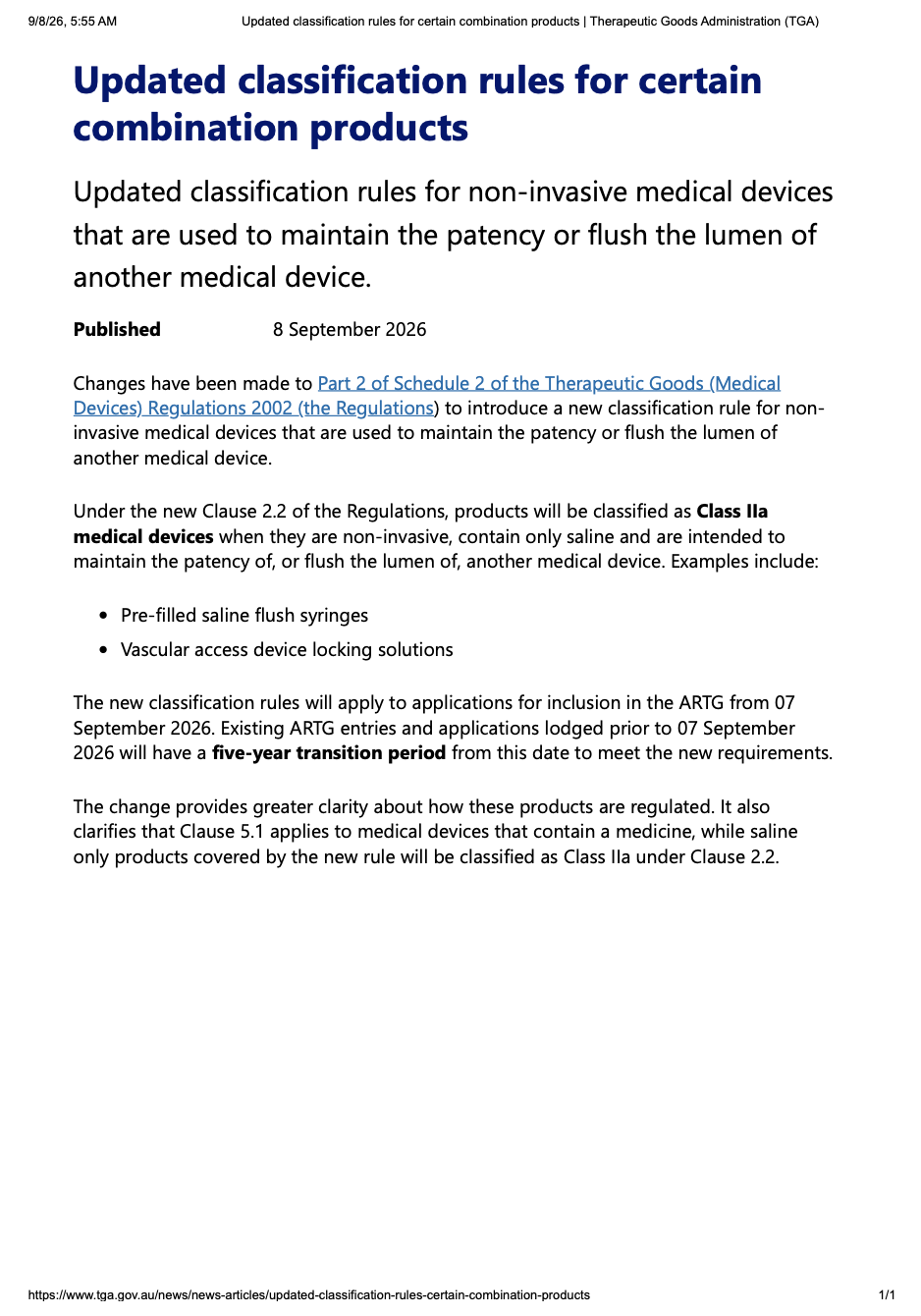
The update concerns non-invasive medical devices that are used to maintain the patency or flush the lumen of another medical device.
New Classification Rule
Changes have been made to Part 2 of Schedule 2 of the Therapeutic Goods (Medical Devices) Regulations 2002 to introduce a new classification rule for these products.
Under the new Clause 2.2, products will be classified as Class IIa medical devices when they are:
non-invasive;
contain only saline;
intended to maintain the patency of another medical device; or
intended to flush the lumen of another medical device.
Product Examples
The TGA provides examples of products covered by the new rule, including:
pre-filled saline flush syringes;
vascular access device locking solutions.
Application Date and Transition Period
The new classification rules apply to applications for inclusion in the Australian Register of Therapeutic Goods, ARTG, from 7 September 2026.
Existing ARTG entries and applications lodged before 7 September 2026 will have a five-year transition period from that date to meet the new requirements.
Clarification of Regulatory Approach
The TGA explains that the change provides greater clarity on how these products are regulated.
It also clarifies that Clause 5.1 applies to medical devices that contain a medicine, while saline-only products covered by the new rule will be classified as Class IIa under Clause 2.2.
Impact on Medical Device Manufacturers
For manufacturers and sponsors of saline-only non-invasive devices used with other medical devices, this update is relevant because it confirms the classification pathway and timing for affected products.
Stakeholders should pay particular attention to:
whether products contain only saline;
whether products are non-invasive;
intended use claims related to maintaining patency or flushing a lumen;
classification under new Clause 2.2;
distinction from devices containing a medicine under Clause 5.1;
ARTG applications submitted from 7 September 2026;
the five-year transition period for existing ARTG entries and earlier applications;
technical documentation and regulatory strategy updates.
For companies placing these products on the Australian market, the key message is that saline-only devices used to maintain patency or flush another device will be regulated as Class IIa medical devices under the new rule, with transition arrangements available for existing entries and earlier applications.