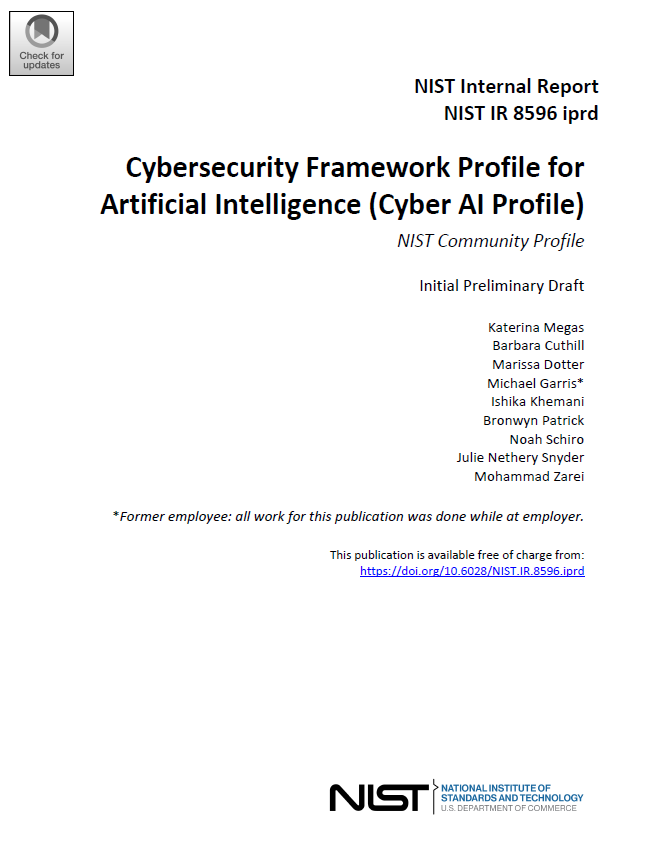
The U.S. National Institute of Standards and Technology (NIST) has published the Initial Preliminary Draft of its Cybersecurity Framework Profile for Artificial Intelligence (Cyber AI Profile)—a document that could significantly shape cybersecurity risk management in AI-enabled technologies, including those in the medical device space.
Why it matters: As medical devices increasingly integrate AI components—from diagnostic algorithms to robotic surgical systems—regulatory expectations around cybersecurity-by-design are intensifying. This new NIST draft provides practical guidance on managing cybersecurity risks introduced by and affecting AI systems.
Key Takeaways for Medical Device Developers
1. Secure AI Systems End-to-End
The draft defines three focus areas:
Secure: Protect AI system components (models, data, infrastructure, supply chains).
Defend: Use AI to enhance cybersecurity functions like threat detection and incident response.
Thwart: Guard against AI-enabled cyberattacks (e.g., adversarial AI, deepfakes).
2. Broad AI Scope
NIST adopts an intentionally broad AI definition covering:
Large language models (LLMs)
Generative AI
Predictive and agentic systems
Expert systems
Hybrid AI approaches
This inclusivity signals that even narrow-use AI modules in medical software may fall within the scope of future expectations.
3. AI-Specific Risks Acknowledged
Risks like model drift, hallucinations, data leakage, and adversarial manipulation are specifically named. For medical devices, these could directly impact diagnostic accuracy, data integrity, or patient safety.
4. Prioritization for Implementation
Each cybersecurity subcategory is assigned a priority level (High, Moderate, Foundational) across the three focus areas. This helps organizations sequence implementation effectively—crucial when balancing innovation with compliance timelines.
Implications for Medical Device Manufacturers
Manufacturers integrating AI (e.g., SaMD with machine learning) should consider aligning risk management plans with the structure proposed by this Profile.
The document may help inform cybersecurity sections of your Technical Documentation, risk files, and clinical evaluation justifications under EU MDR.
For those marketing in the U.S., it may signal the future direction of FDA's AI/ML regulatory expectations—especially given NIST’s close ties to federal standards.
While the document is still an Initial Preliminary Draft, it offers an early window into emerging international consensus on AI-specific cybersecurity, which will likely be referenced by regulators, notified bodies, and standards developers alike.
Read the full draft below.