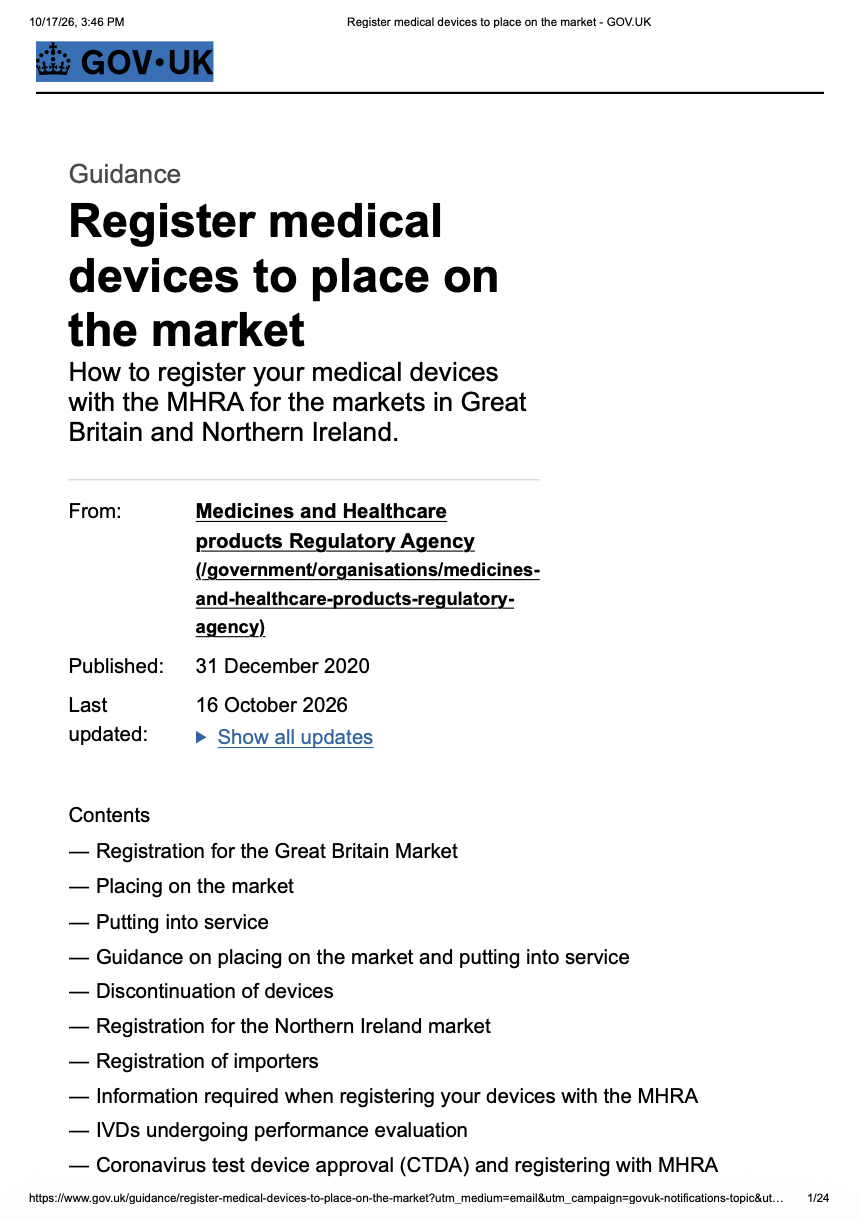
The UK Medicines and Healthcare products Regulatory Agency (MHRA) has updated its guidance “Register medical devices to place on the market” on 16 October 2026.
The guidance explains how manufacturers and other relevant economic operators should register medical devices with the MHRA for the Great Britain and Northern Ireland markets. 1792343860693
Registration Before Placement on the Great Britain Market
All medical devices, including:
in vitro diagnostic devices;
custom-made devices;
systems and procedure packs,
must be registered with the MHRA before they can be placed on the market in Great Britain — England, Wales and Scotland. 1792343860693
Devices must comply with the Medical Devices Regulations 2002 (UK MDR 2002) as they apply in Great Britain.
MHRA also stresses that registration information must remain accurate and up to date. 1792343860693
Registration Does Not Mean MHRA Approval
The guidance makes clear that registration with the MHRA does not constitute:
accreditation;
certification;
approval;
endorsement.
Manufacturers must therefore not make claims suggesting that registration represents MHRA approval or use MHRA logos in marketing materials, packaging, instructions for use or other documentation. 1792343860693
MHRA may also request further technical documentation during its validation and scrutiny of device registration applications.
Who Must Register in Great Britain?
The guidance confirms that registration is required where a company sells, leases, lends or gives away certain devices in Great Britain.
This includes:
Class I, IIa, IIb and III devices;
refurbished or relabelled devices supplied under the company’s own name;
systems and procedure packs;
custom-made devices;
IVDs;
IVDs undergoing performance evaluation. 1792343860693
Manufacturers established outside the UK must appoint a single UK Responsible Person, who assumes responsibility for registering the manufacturer’s devices with the MHRA. 1792343860693
Placing on the Market vs Putting Into Service
MHRA distinguishes between placing on the market and putting into service.
“Placing on the market” refers to the first making available of a device for use or distribution in Great Britain and applies whether the device is supplied commercially or free of charge. 1792343860693
“Putting into service” refers to the point at which the device is made available to the final user. 1792343860693
Where a device is both placed on the market and put into service, MHRA registration is mandatory.
Where a device is put into service only, registration is encouraged but not required. 1792343860693
Discontinuation of Devices
The updated guidance also clarifies the treatment of discontinued devices.
If a manufacturer discontinues a product and no further units are placed on the market, MHRA registration is no longer required once the device is no longer made available in Great Britain.
However, post-market surveillance and vigilance obligations continue for devices already on the market. 1792343860693
This distinction is important for manufacturers managing legacy portfolios or withdrawing products from the GB market.
Northern Ireland and EUDAMED
Registration requirements differ significantly for Northern Ireland.
Since 28 May 2026, all medical devices other than custom-made devices must be registered in EUDAMED before being placed on the EU or Northern Ireland markets.
From that date, MHRA registration is no longer required for those devices. 1792343860693
Custom-made devices remain subject to MHRA registration requirements.
Custom-Made Devices in Northern Ireland
All manufacturers, regardless of location, must register custom-made devices with the MHRA within 28 days of making them available on the Northern Ireland market. 1792343860693
Where a Northern Ireland-based Authorised Representative is appointed, that representative may register the devices on behalf of the manufacturer.
Where the Authorised Representative is based in the EU, the manufacturer remains responsible for registering the custom-made devices with MHRA. 1792343860693
Importer Registration Requirements
For Great Britain, importers must inform the relevant manufacturer or UK Responsible Person of their intention to import a device.
The manufacturer or UK Responsible Person is then responsible for providing the importer’s details to MHRA, including its GB place of business. 1792343860693
Distributors and other suppliers that do not import devices for placement on the Great Britain market do not need to register with MHRA. 1792343860693
Northern Ireland importers must comply with importer obligations under the EU MDR or EU IVDR, and EUDAMED registration has been required since 28 May 2026. 1792343860693
Information Required for Device Registration
MHRA requires detailed manufacturer and device information when registering products.
Manufacturer information includes:
legal entity name and address;
company type;
administrative contacts;
UK Responsible Person letter of designation, where applicable. 1792343860693
Device information may include:
applicable legislation;
risk class;
GMDN code and term;
Basic UDI-DI, where applicable;
device name;
model or version;
catalogue or reference number;
UDI-DI;
UK Approved Body or EU Notified Body;
characteristics such as sterility, latex content or MRI compatibility. 1792343860693
DORS Remains the Registration Platform
Device registration is carried out through the Device Online Registration System (DORS).
Manufacturers must create an account before registering devices, and they are not regarded as registered until device information has been submitted and MHRA confirmation has been received. 1792343860693
2026/2027 Annual Fee Update
A major operational point in the updated guidance concerns the 2026/2027 Annual Fee.
MHRA has recalculated annual fees to reflect the exclusion of applicable registrations for devices that are put into service only. 1792343860693
Outstanding annual fees for devices placed on the market must be paid by 6 November 2026.
Accounts with unpaid annual fees after that date will be suspended. 1792343860693
New Annual Fee Structure
The new fee structure took effect on 1 April 2026, replacing the previous one-off registration fee model.
Manufacturers are now charged annually according to the number of GMDN Level 2 Categories under which their devices are registered. 1792343860693
For the period from 1 April 2026 to 31 March 2027, the unit fee is £300 per year per Level 2 GMDN Category, or Level 1 where no Level 2 category exists. 1792343860693
Ongoing Registration Review
Manufacturers must regularly review their registrations and ensure that information remains current.
MHRA notes that the previous “Renew registration” function was removed from DORS on 1 April 2026, but companies remain legally responsible for keeping registrations accurate and updated. 1792343860693
Changes That May Require New Registration
Certain changes may trigger a statutory fee or require a new registration.
Examples include:
adding devices under a new GMDN Level 2 category;
changing device classification or characteristics;
changing legislation;
changing UK Responsible Person;
adding represented manufacturers. 1792343860693
Other changes, such as updating company contact details, adding products within existing registrations or removing discontinued devices, may be made without a statutory fee. 1792343860693
Transitional CE Certificates
The guidance also maintains information on devices relying on extended EU MDR and IVDR transitional arrangements.
Certain expired or expiring CE certificates may continue to support placement of products on the Great Britain and Northern Ireland markets where the applicable transitional conditions are met. 1792343860693
For applicable devices, manufacturers may need to provide evidence such as a Notified Body letter confirming receipt of the conformity assessment application and conclusion of a written agreement. 1792343860693
Similar arrangements are described for eligible IVDs under the EU IVDR transitional framework. 1792343860693
Impact on Medical Device Manufacturers
For manufacturers, UK Responsible Persons, importers and regulatory teams, the updated guidance highlights several immediate compliance priorities:
verify that DORS registrations remain accurate;
review whether devices are placed on the market, put into service, or both;
remove registrations that are no longer required;
ensure Northern Ireland products are correctly registered in EUDAMED where applicable;
confirm importer information;
review GMDN categories and device data;
ensure annual fees are paid by the applicable deadline;
maintain post-market surveillance after product discontinuation.
The update reinforces the need for active registration lifecycle management rather than treating registration as a one-time administrative activity.