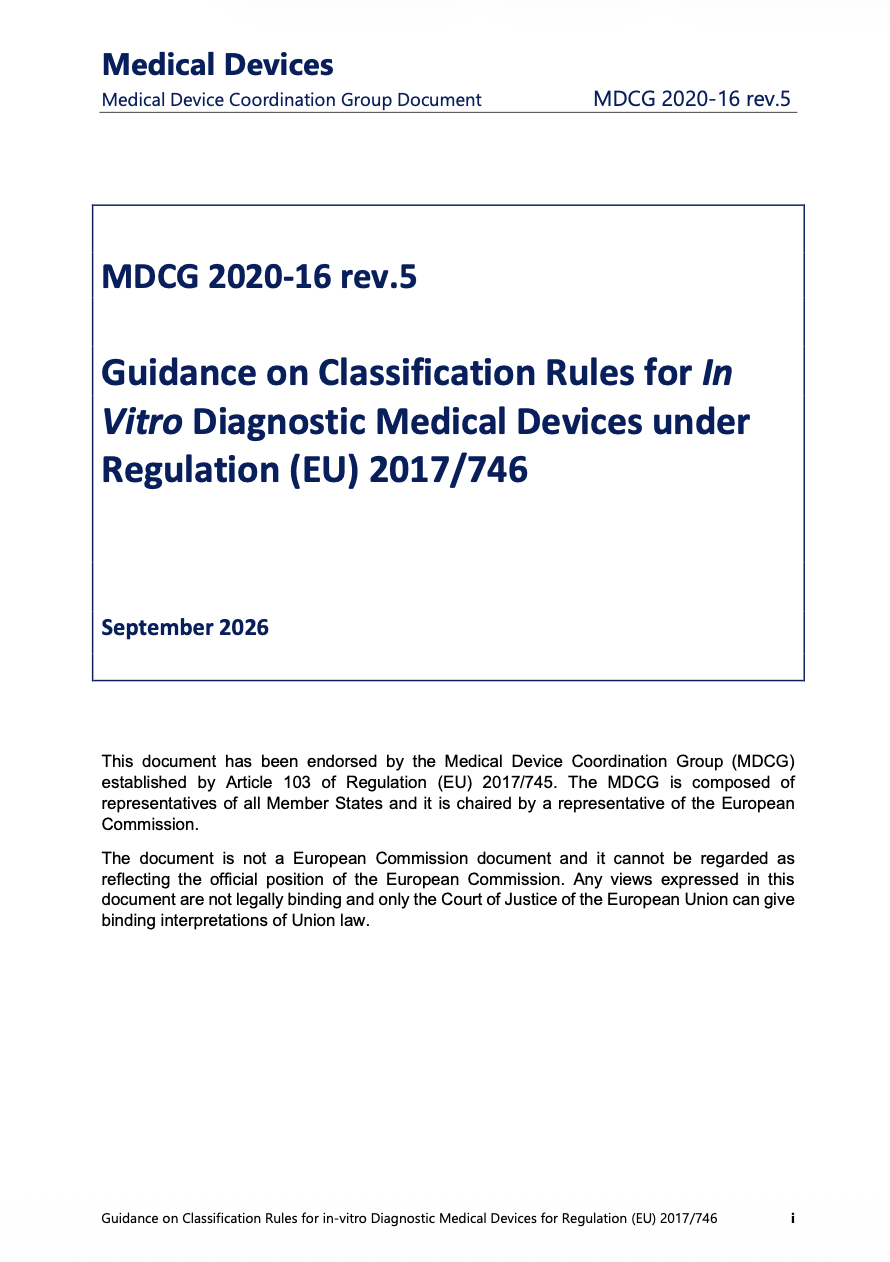
The Medical Device Coordination Group, MDCG, has published MDCG 2020-16 rev.5, titled “Guidance on Classification Rules for In Vitro Diagnostic Medical Devices under Regulation (EU) 2017/746.”
The document is dated September 2026 and provides guidance on the classification of IVDs under the In Vitro Diagnostic Medical Devices Regulation, IVDR.
Main Change in Revision 5
The revision history states that MDCG 2020-16 revision 5 introduces a clarification of the rationale and revision of examples for Rule 7.
Rule 7 concerns controls without a quantitative or qualitative assigned value, which are classified as Class B.
Purpose of the Guidance
The guidance addresses the classification of IVDs and provides clarifications on the classification rules set out in Annex VIII of the IVDR.
It is intended to support manufacturers, notified bodies and health institutions when classifying an IVD before placing it on the market, making it available on the market or putting it into service in the Union. It also informs regulators and other stakeholders when assessing the class attributed to an IVD.
The document also notes that examples are illustrative and not exhaustive.
Classification Principles
Under the IVDR, IVDs are classified into Class A, Class B, Class C and Class D, taking into account the intended purpose of the device and its inherent risks.
The guidance highlights that classification affects key regulatory obligations, including conformity assessment routes, scrutiny of Class D devices, involvement of EU reference laboratories for high-risk devices, consultation requirements for companion diagnostics and post-market surveillance obligations such as PMS reports or PSURs.
Intended Purpose
The classification of an IVD is defined by its intended purpose, as specified by the manufacturer.
This includes the use described on the label, in the instructions for use, in the performance evaluation, and in promotional or sales materials. The guidance emphasizes that ambiguous claims may lead to higher classification.
Application of the Rules
The guidance explains that all implementing rules, classification rules and indents must be considered when classifying an IVD or an accessory for an IVD.
Unless otherwise specified, the rules apply equally across technologies, detection principles and analytical procedures. The rules also generally apply to all specimen types unless a specific rule limits the specimen type.
Software and Devices Used in Combination
For software, the document states that software driving or influencing the use of a device falls within the same class as that device. Independent software is classified in its own right based on its intended purpose.
For devices used in combination, the guidance explains that the classification rules apply separately to each device, and accessories for IVDs are classified separately in their own right. Examples include controls used with reagents and software that drives or influences an analyser.
Overview of the Classification Rules
The guidance provides detailed explanations and examples for the IVDR classification rules.
Examples include:
Rule 1: certain high-risk transmissible agent tests and infectious load monitoring devices classified as Class D;
Rule 2: blood grouping and tissue typing devices, with specific markers classified as Class D;
Rule 3: a broad range of Class C devices, including sexually transmitted agents, companion diagnostics, cancer-related tests, human genetic testing and certain monitoring devices;
Rule 4: self-testing and near-patient testing devices;
Rule 5: certain Class A devices, including general laboratory products specifically intended for IVD procedures, instruments and specimen receptacles;
Rule 6: devices not covered by Rules 1 to 5, classified as Class B;
Rule 7: controls without assigned values, classified as Class B.
Rule 7 Clarification
Rule 7 applies to controls without an assigned value intended by their manufacturers to be used in IVD procedures.
The guidance explains that manufacturers may indicate a range of values in the IFU, but the target values routinely used by the laboratory are determined by the medical laboratory and not by the manufacturer. Such values indicated by the manufacturer for standalone QC materials are not considered “assigned values.” Unless other rules apply, these controls are classified as Class B under Rule 7.
The document also clarifies that controls with quantitative or qualitative values assigned by the manufacturer, including assay kit validity controls, are classified according to implementing rule 1.6.
Examples Under Rule 7
The revised examples for Rule 7 include:
unassigned control sera;
control materials used to verify migration in immunochromatographic assays;
unassigned heterozygous quality control to monitor analytical performance of extraction, amplification and nucleic acid detection;
non-assay specific control plasma for coagulation.
Impact on IVD Manufacturers and Notified Bodies
For IVD manufacturers, notified bodies, health institutions and regulatory teams, MDCG 2020-16 rev.5 is important because classification under the IVDR determines the applicable regulatory pathway and many lifecycle obligations.
Stakeholders should pay particular attention to:
intended purpose and claims;
risk-based classification under Classes A, B, C and D;
classification of software;
devices used in combination;
controls, calibrators and QC materials;
self-testing and near-patient testing claims;
companion diagnostic status;
cancer, genetic and infectious disease testing claims;
Rule 7 controls without assigned values;
consistency between IFU, technical documentation and promotional materials.
For companies placing IVDs on the EU market, the key message is that classification must be supported by a clear intended purpose, careful application of all relevant rules and well-documented justification in the technical documentation.