Health Canada Implements Updated Bioequivalence and Biowaiver Evaluation Templates
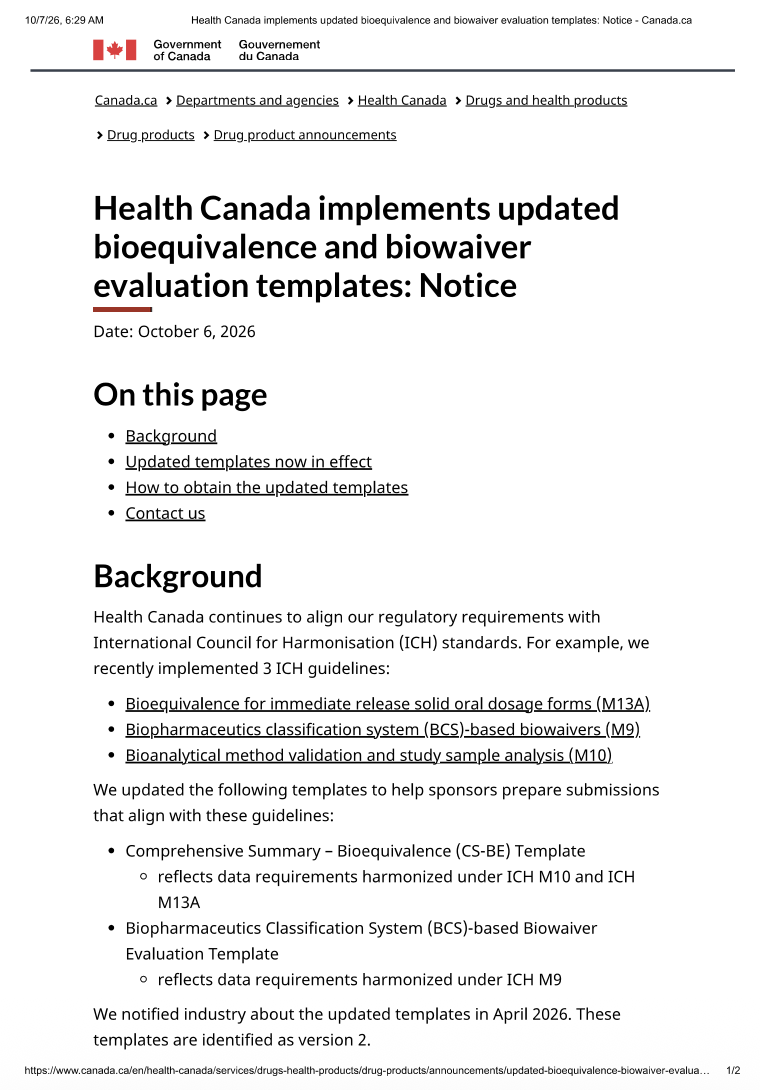
Health Canada has announced the implementation of updated templates for bioequivalence and biopharmaceutics classification system (BCS)-based biowaiver submissions.
The notice, dated 6 October 2026, confirms that the updated templates should now be used for relevant submissions to Health Canada. 1791348980877
Alignment With ICH Guidelines
The update forms part of Health Canada’s continued alignment with International Council for Harmonisation (ICH)standards.
Health Canada highlights the recent implementation of three ICH guidelines:
ICH M13A — Bioequivalence for Immediate Release Solid Oral Dosage Forms;
ICH M9 — Biopharmaceutics Classification System (BCS)-Based Biowaivers;
ICH M10 — Bioanalytical Method Validation and Study Sample Analysis.
The revised templates are intended to help sponsors prepare submissions that are consistent with these harmonised requirements. 1791348980877
Templates Updated to Version 2
Health Canada has updated two key templates:
Comprehensive Summary – Bioequivalence (CS-BE) Template;
Biopharmaceutics Classification System (BCS)-Based Biowaiver Evaluation Template.
The CS-BE Template reflects data requirements harmonised under ICH M10 and ICH M13A, while the BCS-based biowaiver template reflects requirements harmonised under ICH M9. 1791348980877
Health Canada notes that industry was informed about the updates in April 2026, and the revised documents are identified as Version 2.
Updated Templates Are Now in Effect
The notice confirms that the updated templates are effective immediately as of the date of publication.
They are required for submissions such as Abbreviated New Drug Submissions (ANDSs) that include:
bioequivalence studies;
requests for a BCS-based biowaiver. 1791348980877
Use of Older Templates May Trigger a Clarification Request
Sponsors using an older version may receive a screening clarification request from Health Canada.
Following such a request, the sponsor has 30 calendar days to submit the updated Version 2 template.
If the updated template is not provided within that period, Health Canada may issue a screening rejection letter. 1791348980877
This makes the transition operationally important for companies preparing or finalising affected submissions.
How Sponsors Can Obtain the Updated Templates
Health Canada indicates that sponsors should request the relevant template directly by email.
The subject line must clearly identify the requested document, either:
Comprehensive Summary – Bioequivalence (CS-BE) Template; or
Biopharmaceutics Classification System (BCS)-Based Biowaiver Evaluation Template.
The Agency also instructs users not to alter the template format. 1791348980877
Impact on Pharmaceutical Sponsors
For pharmaceutical companies, generic drug manufacturers and regulatory teams submitting applications in Canada, the update has immediate practical consequences.
Sponsors should:
confirm that Version 2 templates are being used;
review internal submission checklists;
update document templates and SOPs;
ensure alignment with ICH M9, M10 and M13A;
verify bioequivalence and biowaiver packages before filing;
avoid submission delays caused by outdated forms.
The most significant operational risk is the use of superseded templates, which can result in clarification requests and potentially screening rejection.
Regulatory Harmonisation
The update also reflects Health Canada’s broader effort to harmonise national requirements with ICH standards.
For multinational development programmes, this may support greater consistency between Canadian submissions and those prepared for other ICH-aligned jurisdictions.
At the same time, sponsors still need to ensure that local Health Canada administrative and formatting expectations are fully met.