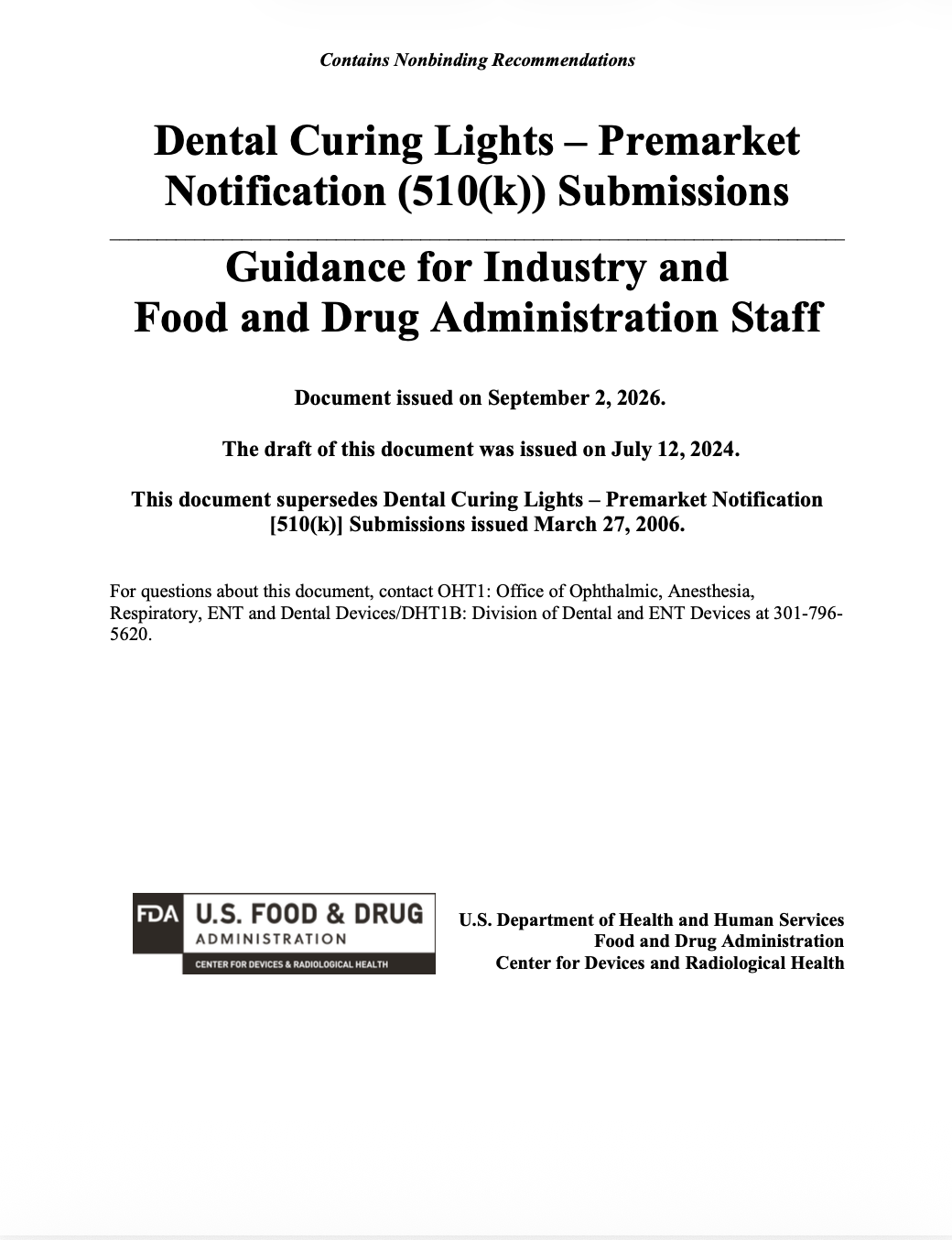
The U.S. Food and Drug Administration, FDA, has issued final guidance titled “Dental Curing Lights – Premarket Notification (510(k)) Submissions.”
The document was issued on 2 September 2026 and supersedes the previous guidance on dental curing lights issued on 27 March 2006.
Purpose of the Guidance
The guidance provides recommendations for 510(k) submissions for dental curing lights.
FDA explains that the devices within the scope of the guidance emit non-ionizing optical radiation intended to photopolymerize dental restorative resins. The guidance is intended to clarify premarket submission expectations, reference relevant consensus standards, promote consistency and facilitate efficient review of submissions.
FDA also notes that the guidance supplements other FDA documents on 510(k) submission content, including 21 CFR 807.87 and the guidance on electronic submission templates for medical device 510(k) submissions.
Scope
The guidance applies to dental curing lights regulated under 21 CFR 872.6070 with product code EBZ, identified as Activator, Ultraviolet, for Polymerization.
It also applies to dental curing lights using broad beam and monochromatic light sources that have been classified under this regulation.
The guidance does not apply to laser devices for polymerization regulated under other regulations or to devices using heat, light or other energy sources exclusively for tooth whitening procedures.
Device Description
FDA recommends that 510(k) submissions include a complete description of the dental curing light, including all components, patient-contacting materials and device features.
Recommended information includes labeled images or illustrations, descriptions of accessories or protective equipment, engineering drawings, power source details, battery type and capacity, light source information, number and placement of LEDs, wattage, operational modes, controls, sensors and alarms.
Predicate Comparison
For devices reviewed through the 510(k) process, manufacturers must compare the new device with a legally marketed predicate device to support substantial equivalence.
FDA recommends providing information showing how the device is similar to and different from the predicate, preferably using side-by-side comparisons. The sample predicate comparison table on page 3 includes parameters such as indications for use, operational modes, light source, power source, accessories, maximum irradiance, radiant power output, peak wavelength, radiant exposure output range and patient-contacting material composition.
Labeling
The guidance states that the 510(k) submission must include proposed labeling in sufficient detail to describe the dental curing light, intended use and directions for use.
FDA recommends that instructions for use include information on total radiant power output, maximum irradiance, peak wavelength, radiant exposure output range, recommended distance and angle of use, disposable sleeve instructions, protective equipment, periodic irradiance checks, thermal hazard warnings and reprocessing information.
Reprocessing
The guidance highlights that many patient-contacting components of dental curing lights are reused and should be adequately cleaned, disinfected and sterilized between uses to minimize infection risk while preventing device degradation.
FDA recommends that manufacturers refer to its guidance on reprocessing medical devices in healthcare settings when developing and validating reprocessing instructions for device labeling.
Biocompatibility
FDA states that manufacturers should determine the biocompatibility of all patient-contacting materials in the device.
Where a legally marketed predicate with the same contact type, contact duration, materials and manufacturing process cannot be identified, FDA recommends conducting and providing a biocompatibility evaluation. The guidance identifies dental curing lights as surface devices with limited contact duration and lists cytotoxicity, sensitization and irritation or intracutaneous reactivity as endpoints to address.
Software and Cybersecurity
The guidance explains that software functions in dental curing lights help control device operation and output.
FDA generally considers dental curing light software functions to require a Basic Documentation Level, although new or unusual indications, applications or technological characteristics may require an Enhanced Documentation Level.
For cybersecurity, FDA notes that dental curing lights may contain software or firmware and may connect to the internet directly or indirectly. If the device meets the definition of a cyber device under section 524B(c) of the FD&C Act, cybersecurity documentation is required as part of the premarket submission.
Electrical Safety, EMC and Wireless Technology
FDA states that dental curing lights are medical electrical equipment and may expose users or patients to electrical hazards or fail to operate properly in the presence of electromagnetic disturbance.
The guidance recommends testing against relevant FDA-recognized standards for medical electrical equipment safety and electromagnetic compatibility, including IEC 60601-1, IEC 80601-2-60 and IEC 60601-1-2.
If the device includes wireless technologies such as Bluetooth, Wi-Fi or RFID, FDA recommends additional testing to demonstrate that wireless functions perform as intended in environments with other wireless products.
Non-Clinical Performance Testing
FDA recommends non-clinical performance testing to fully characterize dental curing lights, noting that descriptive characteristics alone are not sufficient to ensure that the device can perform as intended.
For radiant power output, FDA recommends testing that characterizes total radiant power output, maximum irradiance, spectral irradiance, radiant exposure output range, irradiance attenuation and thermal or beam profile characteristics.
For heat generation, FDA recommends data demonstrating that, under normal and single-fault conditions, the temperature generated by the device remains safe for both the patient and practitioner.
Modifications
The guidance also reminds manufacturers that a device change or modification that could significantly affect safety or effectiveness, or that represents a major change in intended use, may require a new 510(k).
FDA refers manufacturers to its guidances on deciding when to submit a 510(k) for changes to an existing device and for software changes. It also notes that manufacturers interested in proposing a Predetermined Change Control Plan, or PCCP, are encouraged to submit a Pre-Submission to engage with CDRH.
Impact on Dental Device Manufacturers
For dental device manufacturers, the final guidance is important because it updates FDA expectations for dental curing light 510(k) submissions and replaces the 2006 guidance.
Manufacturers should pay particular attention to:
product code and regulation alignment;
device description completeness;
predicate comparison structure;
labeling content for optical output and safe use;
reprocessing validation and instructions;
biocompatibility evaluation for patient-contacting materials;
software documentation level;
cybersecurity documentation for cyber devices;
electrical safety and EMC testing;
wireless technology validation;
radiant power output characterization;
heat generation testing;
change control and potential new 510(k) triggers.
For manufacturers preparing 510(k) submissions for dental curing lights, the key message is that FDA expects a structured submission supported by clear device characterization, robust performance testing, appropriate safety information and alignment with relevant consensus standards.