FDA Highlights Extraction Approaches for Biocompatibility and Chemical Characterization Testing
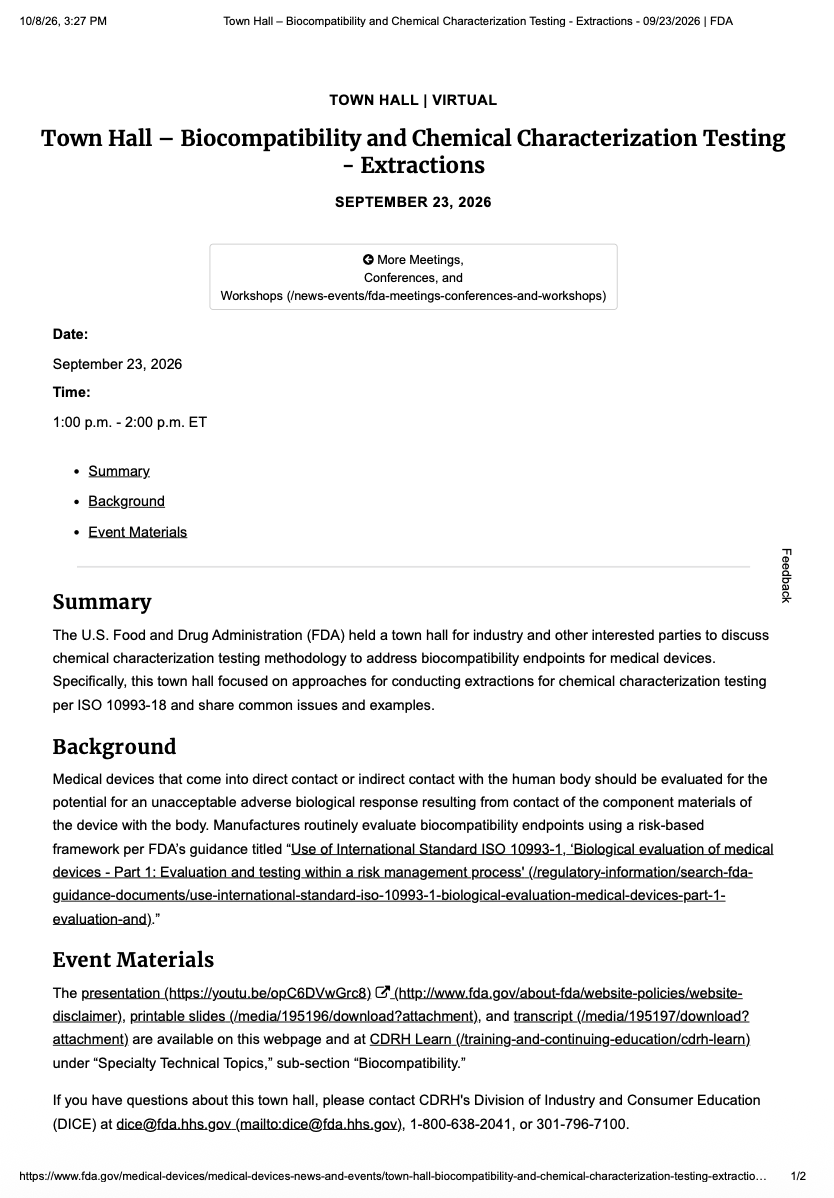
The U.S. Food and Drug Administration (FDA) held a Town Hall on Biocompatibility and Chemical Characterization Testing – Extractions on 23 September 2026. 1791522265640
The session was aimed at industry and other interested stakeholders and focused on chemical characterization testing methodology used to address biocompatibility endpoints for medical devices. 1791522265640
Focus on ISO 10993-18 Extractions
According to the FDA, the Town Hall specifically addressed approaches for conducting extractions for chemical characterization testing in accordance with ISO 10993-18.
The Agency also indicated that the session was intended to share:
common issues;
practical examples;
approaches related to extraction methodology. 1791522265640
For manufacturers, this topic is particularly relevant because extraction conditions can directly influence the substances identified during chemical characterization and therefore affect the broader biological evaluation strategy.
Biocompatibility and Biological Risk
FDA reiterates that medical devices that come into direct or indirect contact with the human body should be evaluated for the potential to cause an unacceptable adverse biological response.
This assessment considers the interaction between the patient and the materials that make up the device. 1791522265640
Risk-Based Approach Under ISO 10993-1
The FDA notes that manufacturers routinely evaluate biocompatibility endpoints using a risk-based framework.
The Agency references its guidance on the use of ISO 10993-1 — Biological evaluation of medical devices – Part 1: Evaluation and testing within a risk management process. 1791522265640
This framework places biological evaluation within the broader context of medical device risk management rather than treating biocompatibility as an isolated testing exercise.
Role of Chemical Characterization
Chemical characterization can form an important part of the biological evaluation process by helping manufacturers understand the chemical constituents that may be released from device materials under defined conditions.
The September Town Hall focused specifically on the extraction stage used in this type of testing.
However, the uploaded FDA page does not provide the detailed scientific recommendations presented during the session. Those details are contained in the associated presentation slides and transcript.
Supporting FDA Materials
FDA states that several supporting materials are available for the Town Hall, including:
the presentation;
printable slides;
the transcript.
These materials are also available through CDRH Learn under the biocompatibility section of the Specialty Technical Topics resources. 1791522265640
Impact on Medical Device Manufacturers
For medical device manufacturers and regulatory teams, the Town Hall reinforces the importance of:
scientifically justified extraction approaches;
alignment with ISO 10993-18;
integration of chemical characterization into biological evaluation;
use of a risk-based approach under ISO 10993-1;
careful consideration of device materials and patient contact.
Where chemical characterization forms part of the biocompatibility strategy, manufacturers should ensure that extraction methodologies are appropriately justified and consistent with the intended use and material characteristics of the device.