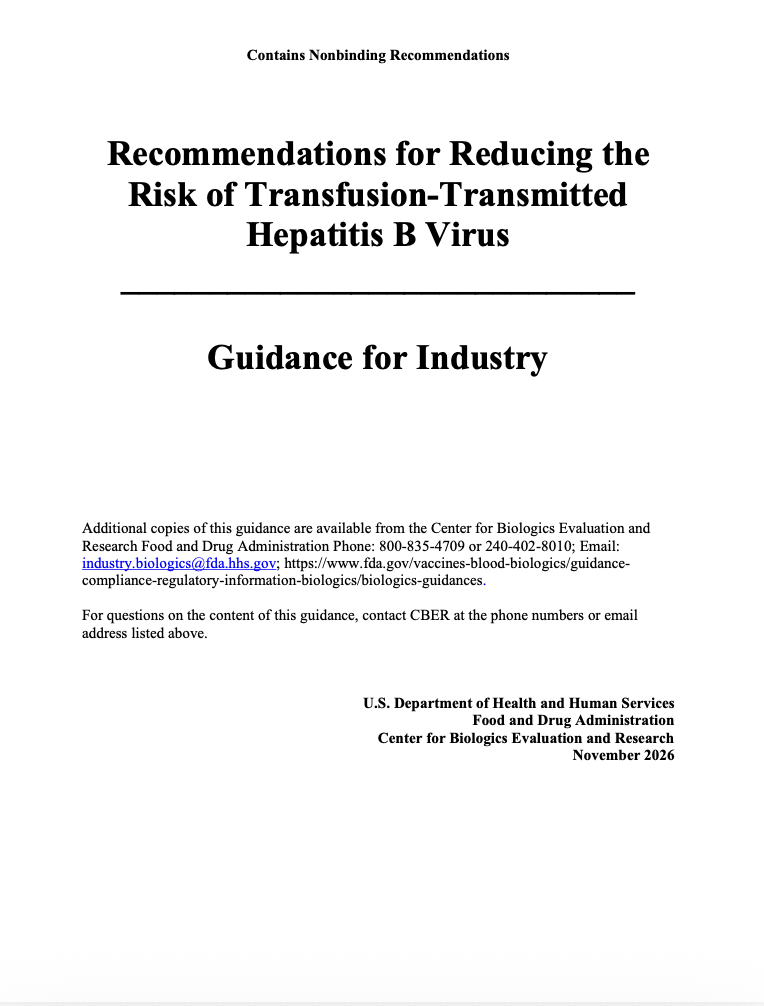
The U.S. Food and Drug Administration (FDA) has issued final guidance titled “Recommendations for Reducing the Risk of Transfusion-Transmitted Hepatitis B Virus”, providing updated recommendations for blood establishments that collect blood and blood components, including Source Plasma.
Published in November 2026 by FDA’s Center for Biologics Evaluation and Research (CBER), the guidance addresses testing, donor deferral and notification, donor requalification, product management, labeling and reporting requirements related to hepatitis B virus (HBV).
Scope of the Guidance
The recommendations apply to the collection of:
Whole Blood;
blood components for transfusion;
blood components for further manufacturing;
Source Plasma.
HBV remains classified as a relevant transfusion-transmitted infection (RTTI) under U.S. regulations, meaning donations remain subject to testing, donor deferral and donor notification requirements.
FDA Finalizes the July 2025 Draft Guidance
The new document finalizes FDA’s July 2025 draft guidance.
It also supersedes several previous FDA recommendations on hepatitis B testing, donor management and requalification, including guidance and memoranda issued between 1987 and 2012.
The most significant change is FDA’s recommendation that HBsAg testing may be discontinued for certain blood donations when HBV DNA NAT and anti-HBc testing are performed.
HBsAg Testing No Longer Necessary for Certain Donations
For Whole Blood and blood components other than Source Plasma, FDA states that testing for hepatitis B surface antigen (HBsAg) is not necessary to reduce adequately and appropriately the risk of HBV transmission when donations are tested using:
HBV DNA nucleic acid testing (NAT); and
antibody to hepatitis B core antigen (anti-HBc).
The tests must be FDA-licensed, approved or cleared and used according to the manufacturer’s instructions.
FDA finalized this recommendation without changes from the July 2025 draft after reviewing public comments and available scientific evidence.
Why FDA Is Changing the Testing Strategy
FDA states that the recommendation reflects:
declining HBV incidence and prevalence in the United States;
extensive experience with blood donor screening;
increasing vaccination coverage;
evidence demonstrating that HBsAg testing does not identify infections missed by both HBV NAT and anti-HBc screening.
The Agency notes that the risk of transfusion-transmitted HBV in the U.S. is currently estimated to be less than 1 in 2 million donations.
Whole Blood and Blood Components
For Whole Blood and blood components other than Source Plasma, FDA recommends that each donation be tested for:
anti-HBc;
HBV DNA by NAT.
Anti-HBc testing must use an individual donation format.
HBV NAT may be performed either:
in minipools;
on individual donations.
The NAT assay may also be a multiplex test that simultaneously detects other agents, such as HIV or HCV.
HBsAg Testing May Still Be Continued Voluntarily
FDA acknowledges that some blood establishments may choose to continue HBsAg testing.
However, if an establishment continues performing the test, it must continue to comply with all applicable regulatory requirements for reactive HBsAg results, including:
further testing;
restrictions on shipment and use;
donor deferral;
donor requalification;
donor notification;
donation suitability.
Different Rules Apply to Source Plasma
The updated recommendation does not apply in the same way to Source Plasma.
FDA continues to recommend that each Source Plasma donation be tested for:
HBsAg;
HBV DNA by NAT.
FDA does not recommend routine anti-HBc testing for Source Plasma.
The Agency explains that anti-HBc reactive plasma may contain hepatitis B surface antibodies that contribute to the safety of certain plasma-derived products.
Why Source Plasma Is Treated Differently
FDA states that available evidence does not currently support discontinuing HBsAg testing for Source Plasma.
Unlike other blood donations, Source Plasma is not routinely tested for anti-HBc, and FDA determined that available blood-donation evidence cannot be directly extrapolated to Source Plasma collections.
FDA notes that future recommendations may be revised if additional scientific evidence becomes available.
Donor Deferral and Notification
Blood establishments must not ship or use donations with a reactive HBV screening result unless a regulatory exception applies.
They must also defer affected donors and notify them of the reason for the deferral.
For anti-HBc-reactive donors, deferral depends on the complete screening profile.
A single anti-HBc reactive result does not automatically require deferral, but deferral is required when:
further testing confirms HBV infection;
another HBV screening test on the same donation is reactive;
anti-HBc is reactive on more than one occasion.
Updated Donor Requalification Recommendations
FDA also provides revised pathways for requalifying some deferred donors.
For Whole Blood and blood component donors, certain donors may be eligible for reentry after additional testing and a defined waiting period.
For example:
a donor with anti-HBc reactive on a second occasion and HBV NAT nonreactive may be considered for reentry after at least 8 weeks;
a donor with reactive HBV NAT and nonreactive anti-HBc may be considered after at least 6 months.
Permanent Deferral in Certain Cases
Some screening combinations remain incompatible with reentry.
For Whole Blood and blood component donors, FDA recommends permanent deferral when HBV NAT and anti-HBc are reactive on the same donation.
Permanent deferral also applies in certain cases involving reactive HBV NAT and confirmed positive HBsAg results.
Source Plasma Requalification
FDA provides separate requalification pathways for Source Plasma donors.
These pathways depend on:
HBV NAT results;
HBsAg results;
confirmatory testing;
whether HBV vaccination occurred within 28 days before the reactive donation;
whether vaccination was routine or related to a specific potential exposure.
The table on page 17 of the guidance summarises Source Plasma donor eligibility, minimum reentry intervals and acceptable test results.
Vaccination-Related HBsAg Reactivity
FDA recognises that recent hepatitis B vaccination can result in transient HBsAg detection.
For certain Source Plasma donors who received vaccination within 28 days before collection, requalification may be possible depending on the reason for vaccination and follow-up test results.
Where vaccination was given solely for future protection or as part of an approved Source Plasma immunisation programme, the donor may potentially return after 8 weeks, provided other eligibility criteria are met.
Product Management and Quarantine
Blood establishments must not ship or use HBV-reactive donations unless an applicable regulatory exception exists.
FDA recommends destroying or appropriately relabeling reactive blood and blood components, unless they qualify for specific research or manufacturing uses.
Relevant units must carry appropriate BIOHAZARD and caution statements where applicable.
Lookback and Previous Donations
When a current donation tests reactive for HBV, FDA recommends identifying previous collections from the same donor made during the prior 12 months.
Within one week, establishments should identify relevant prior units, quarantine in-date components and notify consignees where distributed products are involved.
Disposition then depends on the results of additional testing.
Labeling Changes
The updated testing strategy also affects labeling.
When HBsAg testing is discontinued, the blood establishment must update its Circular of Information to remove references to HBsAg testing results.
For blood components intended for further manufacture, labels must continue to identify applicable RTTI testing results.
Reporting Changes to FDA
Licensed blood establishments that implement the recommendations may need to update their approved biologics license application.
FDA states that establishments that:
discontinue HBsAg testing;
update donor requalification procedures;
revise the Circular of Information;
modify relevant SOPs in line with the guidance;
should report these changes in an annual report under 21 CFR 601.12(d), including the date of implementation.
Unlicensed blood establishments do not need to report these changes to FDA.
Alternative Testing Strategies May Require Prior Approval
FDA considers implementation of an HBV testing strategy materially different from the recommendations in the guidance to be a major change.
Licensed blood establishments using such an alternative strategy must submit a prior approval supplement under 21 CFR 601.12(b).
Impact on Blood Establishments
The final guidance may significantly simplify HBV screening workflows for establishments collecting Whole Blood and blood components other than Source Plasma.
Organisations adopting the revised approach should consider updating:
HBV screening algorithms;
laboratory SOPs;
donor deferral procedures;
donor requalification pathways;
labeling;
Circulars of Information;
quarantine and lookback procedures;
regulatory reporting processes.
Impact on Diagnostic Test Manufacturers
The guidance is also relevant to manufacturers of HBV donor screening assays.
FDA continues to require establishments to use FDA-licensed, approved or cleared tests according to manufacturer instructions.
The document also removes older recommendations specifying particular analytical sensitivity thresholds because currently available FDA-licensed tests already meet the previously recommended detection levels.
For diagnostic manufacturers, this reinforces the role of validated HBV NAT, anti-HBc and HBsAg assays within modern blood-safety strategies.
A Modernised HBV Screening Approach
The final guidance reflects the evolution of hepatitis B screening over several decades.
FDA’s approach has moved from reliance primarily on HBsAg testing toward a combination of molecular HBV NAT testing and serological anti-HBc screening.
For most Whole Blood and blood component donations, FDA now considers this combination sufficient without routine HBsAg testing.
Source Plasma remains subject to a different testing strategy because anti-HBc is not routinely used and supporting evidence for discontinuing HBsAg testing remains insufficient.