FDA Draft Guidance Explains Drug Master File Submission and Review Expectations
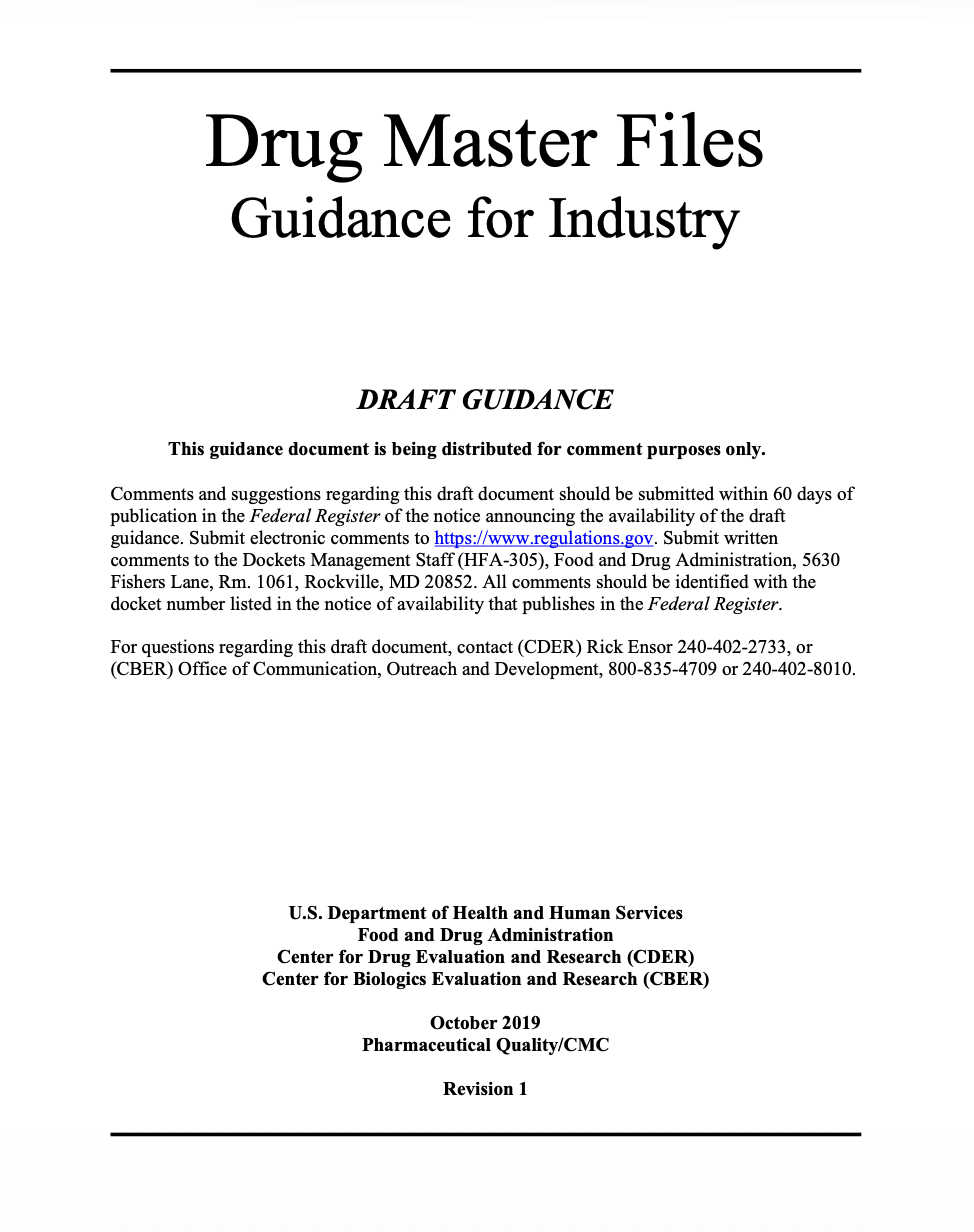
The U.S. Food and Drug Administration, FDA, issued the draft guidance “Drug Master Files” for industry.
The document is a draft guidance, distributed for comment purposes only, and was published in October 2019 as Revision 1 under Pharmaceutical Quality/CMC.
Purpose of the Guidance
The guidance provides FDA’s current thinking on Drug Master Files, or DMFs.
DMFs are submissions to FDA that may be used to provide confidential, detailed information about facilities, processes or articles used in the manufacturing, processing, packaging and storing of human drug products. They can also contain other types of information, such as toxicology information or shared system REMS information.
Use of DMFs
FDA explains that DMF holders can authorize applicants or sponsors to incorporate information contained in a DMF by reference, without disclosing that information directly to the applicants or sponsors.
DMFs are submitted at the discretion of their holders and are not required by statute or regulation. FDA generally does not independently review or approve DMFs; instead, it typically reviews the technical contents of a DMF in connection with an application that references it.
The guidance also clarifies that DMFs can support applications reviewed by FDA, but they are not substitutes for those applications.
Scope
The draft guidance focuses on DMFs used to support:
new drug applications, or NDAs;
abbreviated new drug applications, or ANDAs;
investigational new drug applications, or INDs;
biologics license applications, or BLAs.
FDA also notes that information contained in DMFs can generally be referenced in premarket submissions for devices and animal drugs, although the main focus of the guidance is CDER and CBER submissions.
Types of DMFs
The guidance describes four DMF types:
Type II: drug substance, drug substance intermediate, materials used in their preparation, or drug product;
Type III: packaging material;
Type IV: excipient, colorant, flavor, essence, or material used in their preparation;
Type V: FDA-accepted reference information.
The document also notes that Type I DMFs were discontinued in 2000, although the numbering of the other DMF types has not changed.
Format and Delivery
The guidance states that DMF submissions are subject to electronic submission requirements.
Unless otherwise specified in FDA guidance, DMF submissions must have a DMF number, must be submitted in the required electronic format and, if 10 gigabytes or smaller, must be submitted through the Electronic Submissions Gateway, or ESG. The standard electronic format for DMFs is electronic common technical document, or eCTD.
FDA also emphasizes the importance of selecting the appropriate FDA center, CDER or CBER, when submitting through ESG.
Original DMF Submissions
Before submitting an original DMF in eCTD format, DMF holders must obtain a pre-assigned number.
Original submissions should include a cover letter and complete administrative and technical information in the appropriate eCTD modules.
FDA recommends that cover letters identify the submission type and include a statement of commitment signed by the DMF holder confirming that the DMF is current and that the holder will comply with the statements made in the DMF.
Administrative Information
The administrative section should include information about the DMF holder, agent where applicable, manufacturer and debarment certification.
FDA states that only one company should be listed as the DMF holder and that joint submissions are not accepted.
The guidance also encourages foreign DMF holders to appoint an agent, preferably in the United States, while clarifying that DMF holders remain responsible for the contents of their DMFs.
Letters of Authorization
FDA explains that it will not review a DMF until the DMF holder submits a Letter of Authorization, or LOA, for a specific application or another DMF.
An LOA permits FDA to review the DMF and permits the authorized party to incorporate information into an application or another DMF by reference. However, an LOA does not give the authorized party permission to view or access the DMF.
FDA also states that DMFs must list each party currently authorized to incorporate information by reference, and that the list should be updated whenever a new LOA is submitted or an authorization is withdrawn.
Subsequent Submissions and Amendments
The guidance explains that amendments and additions or deletions of information in a DMF, including LOAs, must be submitted to the DMF.
FDA recommends that subsequent submissions include a cover letter and updated administrative and technical information as needed. DMF holders should also submit a cumulative change history with each subsequent submission.
DMF holders must notify affected authorized parties of DMF changes, additions or deletions and should provide sufficient information to allow authorized parties to determine the appropriate reporting procedure for their applications.
Administrative amendments may include name changes, acquisitions, transfers of ownership, changes to the DMF subject or changes to the DMF type. Technical changes should be submitted as quality amendments.
Type-Specific Recommendations
For Type II DMFs, FDA recommends limiting each DMF to a single drug substance, drug substance intermediate, type of material used in their preparation, or drug product. Separate DMFs should be submitted for drug substances manufactured using different processes.
For Type III DMFs, packaging materials should be identified by type and material of construction, and the DMF may include information on components, materials, controls for release and intended use.
For Type IV DMFs, FDA states that DMFs should generally be submitted only for excipients where CMC and safety information is not available through appropriate regulations or USP-NF quality information.
For Type V DMFs, holders wishing to submit information not covered by Types II through IV must first email a letter of intent to FDA, unless the information concerns manufacturing site, facilities, operating procedures and personnel for sterile manufacturing plants.
Annual Reports
FDA states that annual reports should not be used to report changes in a DMF.
If both an amendment and an annual report are needed, they must be submitted under separate eCTD sequence numbers. Annual reports should include a statement of commitment, administrative information, dates of amendments since the last annual report, a list of authorized parties and a list of withdrawn authorizations.
Failure to submit annual reports may result in termination of the DMF.
FDA Review and Closure
FDA performs administrative review of original DMFs and contacts the holder or agent if information is incomplete.
The DMF will not be available for technical review until administrative filing issues are resolved and the DMF is referenced in an application or another DMF.
FDA performs a technical review of referenced DMF information when an authorized party submits a copy of the LOA in an application or another DMF. The review is performed to support a particular use, and acceptability depends on the specific use described in the referencing submission.
DMFs may be closed at the holder’s request or because FDA cannot be assured that the DMF is current. A closed DMF cannot be reviewed in support of new or amended applications, supplements, INDs or other DMFs.
Impact on DMF Holders and Applicants
For DMF holders, applicants and regulatory teams, the draft guidance is important because it consolidates FDA expectations for DMF preparation, submission, maintenance, authorization and review.
Stakeholders should pay particular attention to:
correct DMF type selection;
eCTD submission requirements;
pre-assigned DMF number requests;
cover letters and statements of commitment;
administrative information completeness;
agent appointment and holder responsibility;
Letters of Authorization;
authorized party lists;
administrative and quality amendments;
cumulative change histories;
annual report obligations;
notification of affected authorized parties;
FDA administrative and technical review processes;
DMF closure consequences.
For companies using DMFs to support FDA submissions, the key message is that DMFs can protect confidential information while supporting applications, but they must be current, properly authorized, correctly structured and maintained throughout their lifecycle.