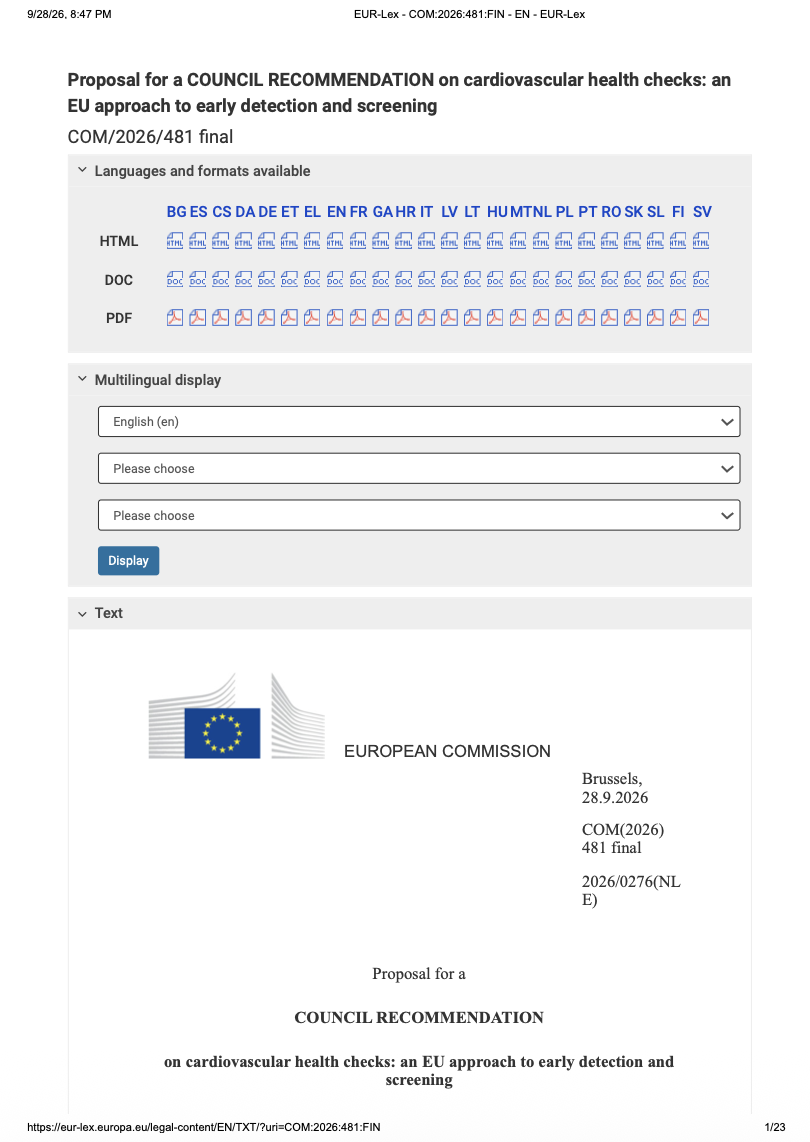
European Commission Proposes EU Approach to Cardiovascular Health Checks
The European Commission has proposed a Council Recommendation on cardiovascular health checks, setting out an EU approach to early detection and screening of cardiovascular disease.
The proposal, COM(2026) 481 final, was published on 28 September 2026 and aims to support Member States in developing and implementing evidence-based, targeted cardiovascular health checks while allowing adaptation to national healthcare systems and priorities. 1790621324262 1790621324262
The initiative forms part of the Commission’s Safe Hearts Plan, which aims to reduce premature cardiovascular mortality by 25% by 2035. 1790621324262 Public Health
Why the Proposal Was Introduced
According to the Commission, cardiovascular diseases remain the leading cause of death and disability in the EU.
The proposal states that cardiovascular diseases:
cause approximately 1.7 million deaths each year;
affect around 62 million people;
create an economic burden exceeding EUR 282 billion annually. 1790621324262
The Commission also notes significant inequalities between countries, regions and population groups.
More than 75% of cardiovascular deaths are linked to modifiable risk factors, including hypertension, diabetes and obesity. 1790621324262
Cardiovascular Health Checks Across the EU
The proposal notes that fewer than half of EU Member States currently have cardiovascular health checks in place and that existing approaches differ considerably. 1790621324262
The proposed Recommendation is therefore intended to provide a common framework while preserving Member States’ responsibility for organising and financing their healthcare systems.
Importantly, this is a proposal for a Council Recommendation, not a binding EU Regulation. The document explicitly states that it does not impose binding commitments on Member States. 1790621324262
Targets for 2035
The proposal sets several objectives linked to the Safe Hearts Plan.
By 2035, it seeks to support Member States in achieving:
a 25% reduction in premature cardiovascular mortality;
annual blood pressure measurement for at least 75% of people aged 25–64 and 90% of people aged 65+;
annual cholesterol measurement for at least 65% of people aged 25–64 and 80% of people aged 65+;
annual blood glucose measurement for at least 65% of people aged 25–64 and 80% of people aged 65+. 1790621324262 1790621324262
Risk-Based and Age-Based Screening
The proposal supports a risk-based, life-course approach rather than a single uniform screening model.
The Commission refers to WHO guidance recommending that age and cardiovascular risk factors be used as entry points for cardiovascular risk assessment. 1790621324262
The annex then proposes different approaches for different age groups.
Individuals Under 35
For individuals below the age of 35, Member States are invited to consider at least one cardiovascular health check.
Possible components include:
health behaviours;
blood pressure;
glucose;
kidney function;
body mass index;
respiratory function where appropriate;
mental health status;
reproductive history where relevant.
Additional personalised evaluation is suggested where there is a family history of premature cardiovascular disease or sudden cardiac death. 1790621324262
Individuals Aged 35 to 64
For adults aged 35–64, the proposal recommends systematic cardiovascular health checks at least every five years, with frequency adapted according to individual risk.
Recommended components include:
medical and family history;
smoking and nicotine use;
alcohol consumption;
physical activity and diet;
blood pressure;
lipid profile;
lipoprotein(a);
fasting plasma glucose;
HbA1c;
kidney function;
body mass index;
waist circumference or waist-to-height ratio;
ECG where clinically indicated. 1790621324262 1790621324262
Individuals Aged 65 and Older
For people aged 65 and older, cardiovascular health checks are proposed every three to five years.
The annex identifies additional possible assessments including:
ECG;
natriuretic peptide testing such as NT-proBNP;
pulse assessment for atrial fibrillation;
cardiopulmonary auscultation;
evaluation for peripheral artery disease where appropriate. 1790621324262
Digital Health and Artificial Intelligence
Digital tools are a significant part of the proposed framework.
The Commission recommends that Member States consider using data-driven and AI-based tools to support cardiovascular risk assessment and health checks, provided that these technologies are:
evidence-based;
clinically validated;
used under appropriate human oversight;
implemented in accordance with applicable EU law. 1790621324262
The proposal also links cardiovascular screening to the EU’s broader Apply AI Strategy, particularly for risk stratification and more targeted screening approaches. 1790621324262
European Health Data Space
The European Health Data Space (EHDS) also plays an important role in the proposal.
The Commission notes that access to existing electronic health information can improve the quality and continuity of cardiovascular health checks.
Relevant electronic health information may include:
medication data;
diagnoses and health problems;
procedures;
medical test results. 1790621324262
The proposal also recommends using digital tools to identify eligible populations, record completed health checks and capture outcomes in accordance with applicable law, including the EHDS framework where relevant. 1790621324262
Secondary Use of Health Data
The Commission also highlights the potential secondary use of cardiovascular health data for:
research;
innovation;
public health policy;
identification of risk factors;
identification of higher-risk populations;
evaluation of prevention strategies. 1790621324262
Data sources may include disease registries, mortality registries, health check data and, where appropriate, genomic and other omics data.
Primary Care and Community-Based Screening
Primary care is expected to be a central setting for cardiovascular health checks.
However, the proposal also encourages broader access through:
pharmacies;
community centres;
workplaces;
mobile units;
screening campaigns. 1790621324262
This is particularly intended to improve access in rural, underserved and difficult-to-reach populations.
Equity and Vulnerable Populations
The proposal places substantial emphasis on reducing inequalities.
Member States are encouraged to consider the needs of:
migrants;
people living in rural areas;
socioeconomically disadvantaged groups;
people with disabilities;
people with co-morbidities;
older populations and other groups facing barriers to preventive care. 1790621324262
The design of screening programmes should also account for sex- and gender-specific cardiovascular risk differences. 1790621324262
Follow-Up and Integrated Care
The Commission stresses that screening alone is not sufficient.
Cardiovascular health checks should be linked to appropriate:
diagnostic testing;
personalised prevention;
treatment;
regular follow-up;
referral pathways.
These measures should form part of an integrated, patient-centred care pathway. 1790621324262 1790621324262
Vaccination as Part of Cardiovascular Prevention
The proposal also notes that vaccination may form part of personalised cardiovascular prevention.
Influenza vaccination is specifically mentioned as an intervention that may contribute to reducing cardiovascular risks and complications. 1790621324262
Monitoring and Evaluation
Member States would be encouraged to regularly monitor both the process and outcomes of cardiovascular health checks.
Evaluation should consider:
effectiveness;
cost-efficiency;
resource utilisation;
participation;
participant outcomes. 1790621324262 1790621324262
The proposal also asks Member States to report to the Commission within three years after adoption, followed by reporting every four years. 1790621324262
Stakeholder Consultation
The Commission reports that its 2026 call for evidence received 237 contributions.
Stakeholder feedback broadly supported structured, protocol-based cardiovascular health checks linked to follow-up care, with primary care as the main delivery setting and complementary community-based options.
Commonly identified minimum parameters included:
blood pressure;
lipid profile;
glucose/HbA1c;
kidney function;
BMI;
lifestyle information;
family history. 1790621324262
Relevance for Medical Device, Diagnostic and Digital Health Stakeholders
Although the proposal is primarily a public health policy initiative, it may have practical relevance for manufacturers and developers of technologies used in cardiovascular screening and risk assessment.
Relevant areas include:
blood pressure monitoring;
laboratory diagnostics;
lipid and glucose testing;
ECG systems;
atrial fibrillation detection;
digital cardiovascular risk assessment;
AI-supported screening;
clinical decision-support software;
interoperable electronic health records;
health data platforms;
cardiovascular diagnostic devices.
The proposal does not create new medical device conformity assessment requirements. Instead, it may influence how cardiovascular screening programmes are organised and which clinically validated technologies are used within those programmes.
Next Steps
The document is currently a European Commission proposal for a Council Recommendation.
Any final Recommendation would require adoption by the Council of the European Union. Member States would retain responsibility for how cardiovascular health checks are designed and implemented within their national healthcare systems. 1790621324262
The Commission describes the initiative as part of its broader cardiovascular health work under the Safe Hearts Plan.