European Commission Expands MDR List of Devices Exempt from Clinical Investigations
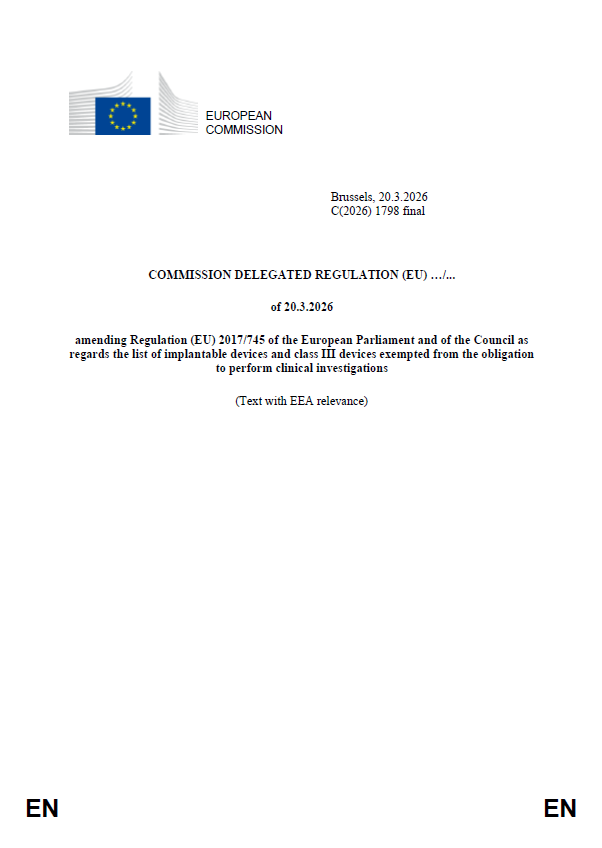
On 20 March 2026, the European Commission adopted a Delegated Regulation amending Regulation (EU) 2017/745 (MDR) regarding the list of implantable and Class III devices exempted from the obligation to perform clinical investigations.
Background
Under Article 61(6)(b) MDR, certain devices may be exempt from clinical investigations if they are considered well-established technologies (WET).
According to the Commission, WET are devices that:
Have common and stable designs
Have well-known safety and clinical performance characteristics
Have a long history on the market
Criteria for identifying WET have been previously defined in MDCG 2020-6 guidance.
What has changed?
Based on experience with the MDR, the Commission has expanded the list of implantable and Class III devices that may benefit from exemption from clinical investigations.
The amendment replaces Article 61(6)(b) and introduces an extended list of device types, including:
Sutures, staples, dental fillings, dental braces, tooth crowns
Screws, wedges, plates, wires, pins, clips, connectors
Cranial perforators, catheter passers, cannulas, needles
Catheters (including anticoagulant-coated), introducers, dilators
Feeding tubes, ventricular drains, gastrostomy buttons
Bone-related products (e.g. bone fillers, bone substitutes, bone wax)
Dental implants, orthodontic devices, dental veneers
Guidewires, pacing wires and leads
Embolisation coils and particles
Shunts and internal defibrillation paddles
Reusable surgical instruments
Consultation process
The list was developed in 2025 following consultation with stakeholders, including:
MDCG working groups
Competent Authorities
Other relevant stakeholders with observer status
Important requirement remains
Although these devices are exempt from the obligation to perform clinical investigations, manufacturers must still:
Plan, conduct and document a clinical evaluation in accordance with Article 61 MDR
Ensure that the clinical evaluation is based on sufficient clinical data
Comply with relevant Common Specifications (CS) where available
Entry into force
The Regulation will enter into force 20 days after its publication in the Official Journal of the European Union.
Read the full document below.