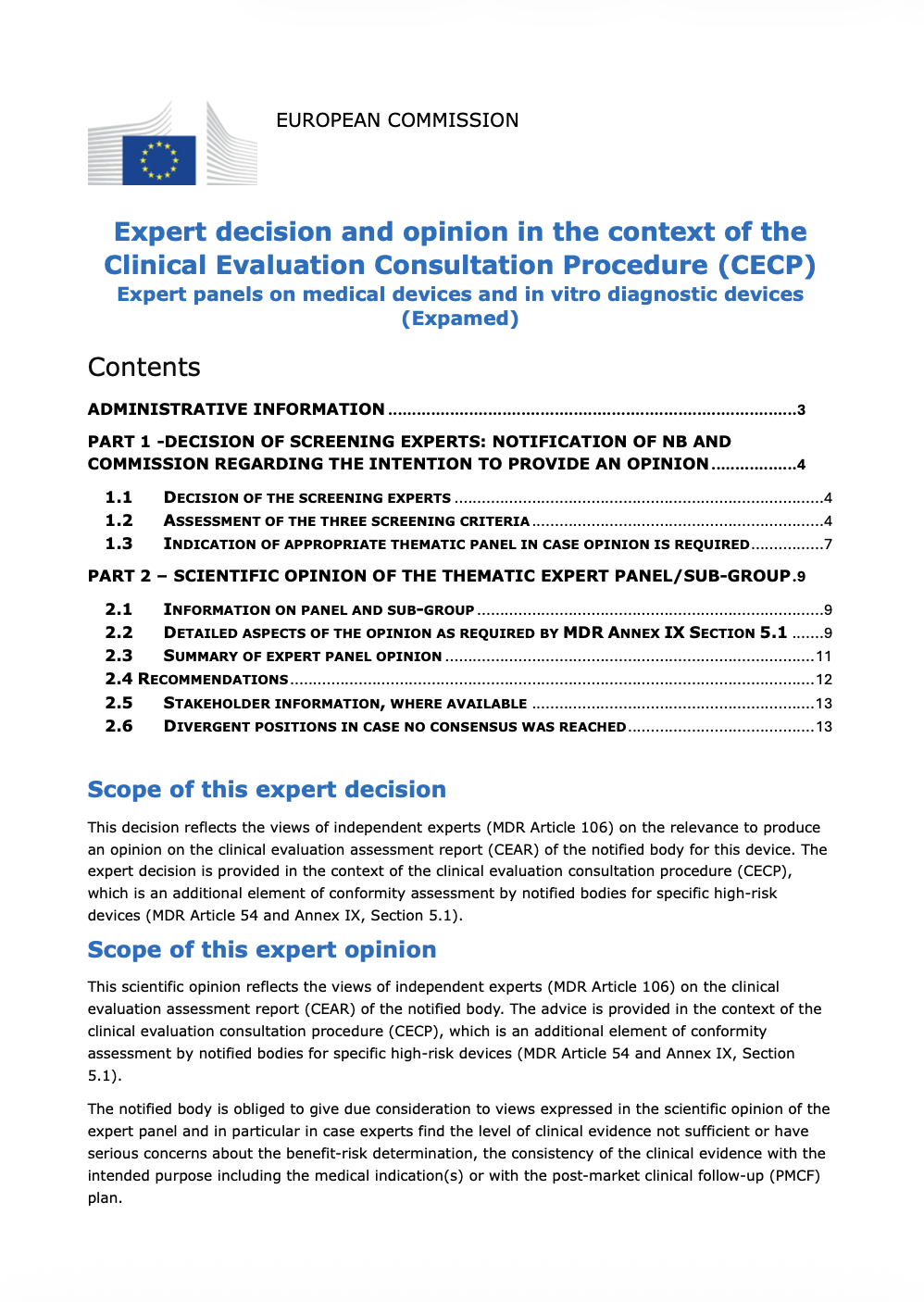
EU Expert Panel Raises Clinical Evidence Concerns in CECP Opinion on Class III Knee Device
The European Commission’s medical device Expert Panel has issued a scientific opinion under the Clinical Evaluation Consultation Procedure (CECP) concerning a Class III resorbable filling and reconstruction deviceintended for intra-articular injection in patients with mild to moderate knee osteoarthritis.
The CECP dossier, EMA/EX/0000335537, began on 10 March 2026 and involved Notified Body 2797. The device was assessed within the field of orthopaedics, traumatology, rehabilitation and rheumatology.
Why the Device Was Selected for Expert Review
The screening experts decided on 16 March 2026 that a scientific opinion was required.
According to the decision, the device combines a DSPC-based liposomal suspension with an MPC/PMPC-containing lipid-polymer conjugate, intended to stabilise the liposome surface.
Although the individual components were not considered entirely new, the experts considered the specific combination and its use as an intra-articular injection in osteoarthritic knees to represent a major level of novelty with potentially significant clinical or health impact.
High Level of Novelty
Under Criterion 1, the screening panel classified the device as having a high level of novelty.
The experts described it as a new intra-articular injectable product developed for mild to moderate knee osteoarthritis. The claimed mechanism involves highly hydrated liposomes forming a protective coating over cartilage following injection.
The clinical procedure itself — intra-articular knee injection — was not considered novel, but the specific device composition and stabilisation approach were.
Pre-Market Clinical Evidence
The dossier included two pre-market clinical investigations:
a first-in-human open-label study;
a randomised, double-blind, placebo-controlled clinical trial.
Patients were followed for 26 weeks after a single intra-articular injection.
The screening experts noted reported improvements in pain and function, with few adverse events and no serious adverse events observed in the studies.
However, they also considered the follow-up period relatively short given the novelty of the device.
Potential Clinical or Health Impact
The screening experts classified the possible clinical or health impact related to the device’s novel aspects as major.
Although only a limited number of adverse events had been observed, the panel considered the 26-week follow-up insufficient to fully characterise potential risks associated with the novel composition and therefore concluded that a thematic expert opinion was necessary.
Expert Panel Opinion
The final scientific opinion was issued on 8 May 2026 by the Orthopaedics, Traumatology, Rehabilitation and Rheumatology Expert Panel, within the subgroup for non-articulating devices and rehabilitation.
The panel agreed that the Notified Body’s assessment of the clinical evaluation assessment report was thorough, structured and well documented.
However, the experts considered that the critical appraisal of the manufacturer’s claims was insufficient.
Questions Around Clinical Superiority
One of the key concerns related to the claimed clinical benefit that the device reduces wear-associated pain.
The pivotal trial was designed to demonstrate superiority over saline placebo using functional outcomes including KOOS pain subscore and Numeric Rating Scale (NRS).
The expert panel concluded that the available results did not demonstrate superiority over placebo and highlighted wide confidence intervals that could be compatible with no clinically relevant effect.
Benefit-Risk Assessment
The panel disagreed with the Notified Body’s conclusion that the study demonstrated clinically meaningful improvement in both primary and secondary endpoints.
The experts noted that:
the confidence interval crossed the minimal clinically important difference threshold;
the lower confidence interval crossed zero at certain time points;
the estimated mean difference remained below the referenced 8-point threshold throughout follow-up.
On this basis, the experts considered the pivotal study results inconclusive and stated that any effect observed may not be clinically meaningful compared with saline injection.
Potential Risk of Foreign Body Synovitis
The opinion also raises concerns about the novel lipid-polymer conjugate used in the device.
The experts noted that a remaining non-resorbable component could potentially contribute to foreign body synovitis, particularly in the context of repeated injections.
The panel considered that this risk had only been evaluated pre-clinically and recommended further characterisation through post-market clinical follow-up.
Promotional Claims Not Supported by Clinical Data
The manufacturer had also made two additional claims:
the device reduces wear to enable smooth motion;
the device provides a long-lasting mechanical “cushion” to enable ease of movement.
According to the Expert Panel, these claims were supported only by pre-clinical evidence.
The panel recommended that the claims should not be used in the instructions for use, online content or promotional materials until supported by clinical data.
Intended Purpose Considered Consistent
Despite its concerns, the Expert Panel agreed with the Notified Body that the clinical evidence was consistent with the device’s intended purpose — use in patients with mild to moderate knee osteoarthritis.
The main concerns therefore related to the strength of performance claims, benefit-risk conclusions and the adequacy of the post-market evidence strategy rather than the stated indication itself.
PMCF Plan Considered Not Fully Comprehensive
The panel also reviewed the relationship between the available clinical evidence and the Post-Market Clinical Follow-up (PMCF) plan.
It concluded that the Notified Body’s assessment of the PMCF plan was not fully comprehensive with respect to the device’s three clinical claims.
The experts recommended that future PMCF activities capture:
co-medications and co-treatments such as physiotherapy and diet;
a clearer definition of the broader intended patient population;
stronger confirmation of efficacy and performance;
specific evaluation of repeated injections;
further assessment of foreign body synovitis risk.
MRI Recommended for Promotional Claims
For the two mechanical or promotional claims, the panel recommended adding cartilage-specific MRI at baseline and at a minimum of one year post-treatment.
The objective would be to determine whether the claimed reduction in wear and cushioning effect are supported by clinical evidence.
Additional Post-Market Clinical Evidence Recommended
The panel considered the clinical evidence insufficient to support all three claims and recommended additional data collection post-market.
For the superiority claim, the experts suggested that a future study could include:
a double-blind randomised controlled design;
preferably three arms;
comparison with both state-of-the-art treatment and placebo;
at least one year of follow-up;
documentation of permitted medications and co-treatments;
systematic collection of clinical scores and adverse events.
Restrictions on Claims
Until sufficient clinical evidence is available, the Expert Panel recommended that the two promotional claims relating to reduced wear and a long-lasting mechanical cushion should not appear in:
instructions for use;
online materials;
promotional communications.
This highlights the importance of ensuring that clinical claims remain aligned with the available level of evidence throughout conformity assessment and post-market activities.
Role of the Notified Body
Under the CECP framework, the Notified Body is required to give due consideration to the Expert Panel’s scientific opinion.
Where the Notified Body decides not to follow the panel’s advice, it must provide a full justification in its conformity assessment report.
The Notified Body may also need to require actions such as:
restrictions to the intended purpose;
limitations on certificate validity;
specific PMCF studies;
updates to the instructions for use;
changes to the Summary of Safety and Clinical Performance;
other conformity assessment restrictions.
Impact on High-Risk Medical Device Manufacturers
For manufacturers of Class III and other high-risk medical devices, this CECP opinion illustrates the level of scrutiny that may be applied to clinical evidence, benefit-risk assessments and product claims.
Stakeholders should pay particular attention to:
robustness of pivotal clinical study design;
clinically meaningful endpoints;
interpretation of confidence intervals;
superiority claims;
alignment between CER and CEAR conclusions;
adequate clinical support for promotional statements;
long-term follow-up for novel technologies;
PMCF study design;
evaluation of novel material-related risks;
consistency between clinical evidence and intended purpose;
Notified Body documentation of Expert Panel feedback.
The broader lesson is that novel device technology and positive pre-market observations alone may not be sufficient to support strong clinical claims where statistical uncertainty remains or where long-term risks are insufficiently characterised.