EU Expert Panel Identifies Clinical Evidence Limitations for Bioabsorbable Orthopaedic Screws under MDR CECP
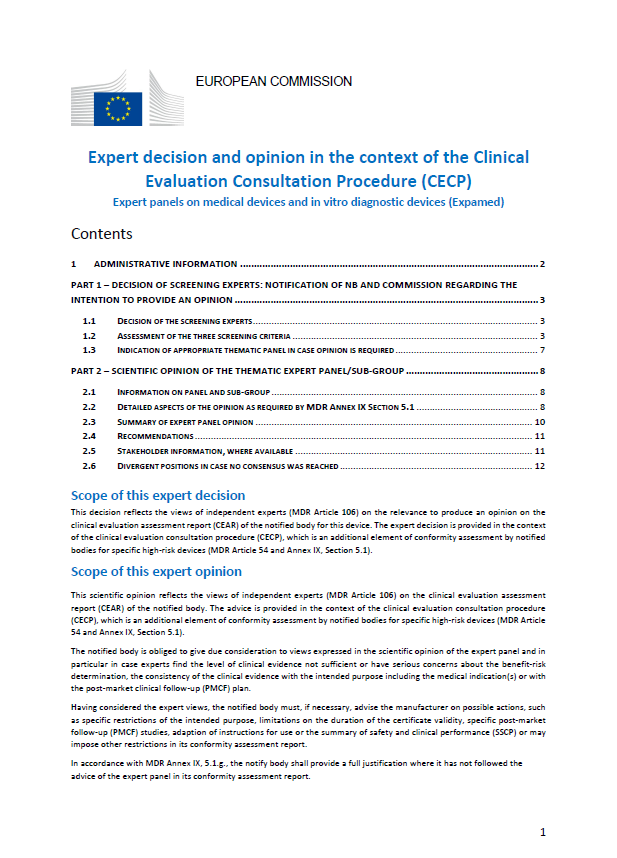
The European Commission has published an expert panel decision and scientific opinion במסגרת the Clinical Evaluation Consultation Procedure (CECP) for a Class III implantable bioabsorbable orthopaedic screw intended for fracture fixation and osteotomies.
Scientific Opinion Requested by Screening Experts
The screening experts decided that a scientific opinion should be provided, based on:
Medium level of novelty
Moderate potential clinical/health impact
Presence of open issues regarding safety and performance
The device, based on magnesium (Mg), calcium (Ca), and zinc (Zn) alloy, may offer benefits such as avoiding removal surgery and potentially improving recovery. However, safety and performance aspects require systematic appraisal.
Key Findings from the Expert Panel
Limited Clinical Evidence
The expert panel concluded that:
The notified body’s clinical evaluation assessment report (CEAR) includes important issues that are not sufficiently addressed
Clinical data is mainly based on:
Literature including non-equivalent devices
A single prospective non-randomized feasibility study conducted in one center
There is no sufficient clinical data demonstrating the degradation duration and implant stability in humans
Concerns Related to Mg-Alloy Degradation
The panel highlighted that:
Degradation of the magnesium alloy starts upon implantation
The process may be accelerated due to device design (e.g. cannulated screws)
There are uncertainties regarding degradation behaviour and mechanical stability over time
In addition, identified risks associated with Mg-alloy screws include:
Inflammatory reactions and osteolysis
Lower load-bearing capacity compared to metallic implants
Rapid degradation leading to premature loss of mechanical integrity
Hydrogen gas formation
Accumulation of degradation products
Potential toxicity concerns from alloying elements
Challenges in controlling degradation rate
Benefit-Risk Determination Not Adequately Supported
According to the expert panel:
The benefit-risk determination relies mainly on non-clinical data and literature
Some referenced studies involve devices with different alloy compositions
Certain conclusions (e.g. bone regeneration and implant replacement) are not supported by sufficient clinical evidence
The panel states that additional clinical data is required to properly assess the benefit-risk profile.
Insufficient Evidence Across Indications
The device is intended for multiple fracture types and anatomical locations. However:
Clinical evidence is provided only for medial malleolar fractures
Different indications involve different biomechanical requirements
The panel concluded that each indication should be supported by appropriate clinical data.
PMCF Plan Lacks Detail
The expert panel noted that the PMCF plan:
Provides limited detail on clinical follow-up
Does not clearly define:
Monitoring of degradation
Assessment of bone healing
Timepoints and imaging methods
Further clarification is required, including use of radiographs and CT scans at defined intervals.
Expert Panel Recommendations
The panel recommends that the notified body request the manufacturer to:
Conduct a literature review on Mg-alloy degradable screws
Perform a pre-authorisation clinical study comparing with standard fixation methods
Conduct a post-authorisation clinical study, including:
Radiographs at defined timepoints (e.g. 6 weeks, 3 months, 1 year)
CT scans (e.g. 6 months and 1 year)
Conclusion
The expert panel concludes that:
Additional clinical evidence is required
Current data is insufficient to support key claims and the benefit-risk determination
Further studies are needed to address uncertainties related to degradation, stability, and clinical performance.
Read the full document below.